Two churches

This morning I attended 11 a.m. Mass at St Patrick’s Cathedral in Auckland, as I have done almost every Sunday morning for seventeen years. Being a member of the choir, I watch the proceedings from up in the organ loft.

cathedral mass

Services at St Patrick’s are traditional, based on the same format that has been used for centuries in Catholic churches all over the world. In the choir we mostly sing classical four-part motets, in either English or Latin; today’s programme included Call to Remembrance (Farrant), O Lord Increase my Faith (Gibbons) and Ave Verum Corpus (Elgar). Singing such pieces requires concentration, but there is also time to appreciate the beauty of the liturgy and the music, and the prayerful atmosphere of the setting.

After a brief lunch break I walked up the road to St Matthews in the City for a very different experience at the annual Blessing of the Animals service organised by the SPCA. The church was packed with people and animals, mostly dogs, some of them extremely active and vocal. The programme of hymns, songs from a school choir, poems and talks was mainly cheerful, though some aspects – lighting a candle for pets who have died, and prayers for animals who suffer abuse – were quite emotional.

fullsizeoutput_3fd

It is said there are many spiritual paths, all equally valid. Today’s two services could hardly have been more different, but both were uplifting.


Bach flower remedies and orthodox psychiatry: a comparison

After working as a psychiatrist in England, I became a Bach flower practitioner in New Zealand. The Bach flower remedies are a long-established complementary therapy intended to improve emotional balance. While not an adequate treatment for serious forms of mental illness, they can be used for the same sort of problems – anxiety and phobias, mild to moderate depression, responses to loss or stress, adjustment reactions, relationship difficulties – that often present in mental healthcare settings. Without a clinical trial, it would be impossible to say whether Bach flower therapy, orthodox psychiatric treatment or a combination of both works best. There are several points of contrast between the two approaches, as outlined below.

The style of interview: The traditional psychiatric interview and mental state examination involves asking patients a great many questions, covering not only the detail of their present complaints, but also their life history and social circumstances. This elicits a great deal of information, some of which may be highly relevant for future management, but some patients may find it intrusive or feel it does not allow them enough time to express their real concerns. A Bach consultation, in contrast, is more exclusively focused on current emotional state, and it is up to the clients to reveal as much or as little as they wish. Practitioners may ask for clarification, but do not probe too deeply – a key word is Simplicity. I believe this is more relaxing and therapeutic for those on the receiving end, however it may mean that important material – for example symptoms of a medical disorder, or suicidal ideation – is missed.

The diagnostic assessment: Psychiatrists assign their cases to a diagnostic category from the official classification systems, ICD or DSM. These categorisations are valuable in enabling research into the causes and treatments for different conditions. Bach practitioners, in contrast, make little or no use of diagnostic groups but aim to understand exactly what negative emotions the individual is currently experiencing; for example the same client might be feeling fear for no apparent reason, combined with regrets about the past and lack of confidence to apply for a new job.

Medication: A great advantage of Bach flower remedies over psychotropic drugs is their lack of side effects or interactions. They can also be more accurately tailored to the individual case, as up to six of the 38 flowers can be mixed together, giving rise to multiple possible combinations; suitable remedies for the fictional client described above would be Aspen, Honeysuckle and Larch. The key question is whether they work? Many authorities are sceptical, given that their mode of action is obscure and that most  published trials have shown no significant advantage over placebo. However most of the trials have not used the remedies correctly, having given all subjects the same mixture rather than individual prescriptions chosen at interview. The lack of scientific validation stands in contrast to the worldwide popularity of the therapy, still continuing 90 years since it was first developed by Dr Edward Bach. I have found that about 80% of clients respond well, a success rate comparable to that seen with psychotropic drugs. I have not been able to find any randomised trials comparing Bach flowers with antidepressants or anxiolytics, and would be pleased to hear of any that I have missed.

Relationship with patients/clients: While doctor-patient relationships are no longer so authoritarian as in the past, the doctor (or other orthodox clinician) is in charge, the patient has a passive role, and there are firm professional boundaries. With Bach flower treatment there is a more informal and egalitarian relationship, with clients being encouraged to take part in choosing the remedies they need. I have never found this familiarity abused, having had many friends as clients, and clients who have become friends. It is stated in the Bach Foundation code of practice that clients remain responsible for their own well-being, and I believe this self-responsibility contributes to the success of the treatment – though it would not be appropriate for cases of severe psychiatric illness, which should not be treated solely by Bach flowers in any case.

Psychological treatments: In mental health settings, a range of psychotherapeutic techniques may be used either alongside or instead of drugs. Formal psychotherapy is not part of Bach flower treatment, although all practitioners need basic counselling skills, and some are qualified to use other methods that can successfully be combined with the flowers – I have used my life coaching training in this way.

Professional support: Clinicians working in a public health service are obliged to interact with colleagues, fulfil requirements for audit and continuing education, and attend meetings. All this helps with maintaining standards and keeping up-to-date, though can divert time and energy from direct patient care. In contrast, Bach flower practitioners often work in isolation and are not strictly regulated. They have more time and energy for their clients, and are very unlikely to cause them direct harm, but there is some risk they may fail to recognise a serious mental or physical disorder that needs prompt medical assessment.

A few psychiatrists around the world already use Bach flowers in their practice, and there seems no reason why these remedies could not be more widely integrated with orthodox treatments.


Walking for the animals

Following on from Zumba Gold and cold water swimming, my exercise challenge for today was a brisk walk in the Auckland suburb of Hobsonville. I did this partly for health benefits but more importantly to raise awareness for my favourite charity, the Society for Prevention of Cruelty to Animals or SPCA. A group of supporters, many with their dogs, gathered at the site where a new centre serving the North Shore area is to be built next year. Brian came too.

Although there are plenty of animal lovers in New Zealand, there are also many cases of cruelty and neglect. I know from my years of volunteering with the SPCA that the organisation does wonderful work in rescuing, rehabilitating and rehoming animals, educating school children about animal welfare, running low-cost desexing programs to prevent litters of unwanted kittens, seeking justice in cases of animal abuse, and more.

Until now the SPCA has operated from the Animal Village in Mangere in South Auckland, close to the airport. As the city’s population has grown, not only are these premises too small, but traffic congestion is making it very difficult to service the area efficiently. The new centre in Hobsonville will make it possible to help many more animals such as my own beautiful Magic (pictured), who was brought into the SPCA as the only survivor of a litter of kittens left to die under a hedge. More funds are still needed to build the centre and donations can be made through https://www.spcaauckland.org.nz.

Magic on cyclamen bed


Style after 70

With spring on the way, this feels like a good time to sort out my wardrobe. Despite my policy of giving away one garment whenever I get a new one, I have too many clothes and some of them no longer seem suitable.

Circumstances, priorities and bodies change with advancing age, often calling for adaptations in dress style. Some older women become more adventurous and frivolous, following the latest fashion trends or putting purple highlights in their hair. Some stick to a safe formula such as wearing only black, white or navy blue. Some have clearly lost all interest in their appearance, and opt for the comfort and convenience of old tracksuits. Personally I have become rather more conservative, aspiring to a simple practical and classic look, and hoping to avoid any impression of “mutton dressed as lamb”. So all my shorts and jeans, and anything too brightly coloured, will be going to the charity shop.

But other superfluous garments are hard to part with. Some have sentimental value because they were given to me by someone I care about, or bring back memories of a special occasion. Some that were quite expensive to buy have become faded and out of date, having languished too long in the cupboard being “saved for best” and hardly ever worn. Some are old favourites that I still wear a lot, but probably shouldn’t because they look awful if I happen to see them in a photo of myself. Others simply “might come in”. I suppose it is an exercise in letting go of the past and I could apply Marie Kondo’s advice to “keep only clothes that bring you joy”, as described in her book The Life-Changing Magic of Tidying Up.

My long-held ideal is having a wardrobe planned according to a logical system: a certain number of clothes of each type for each season, all colour-coordinated of course. Despite many attempts over the years I have never quite managed to achieve this. Fashion – and life – is always changing, and can never be perfect.

File 14-08-17, 12 20 13 PM


Cold water swimming

Inspired by Floating, Joe Minihane’s memoir about swimming in seas, rivers and lidos around the UK, I plan to do more outdoor swimming this year. I have ample opportunity here in New Zealand, being lucky enough to live in a house with a pool in the garden and ten minutes walk from the sea. I already swim most days during the hot summer months but intend to try extending the season.

Swimming, especially in cold water and sea water, seems to confer mental and physical health benefits over and above those to be gained from exercise in general. Mechanisms for this include the physiological stimulation of being in cold water, the meditative state induced by rhythmic movement and deep breathing, being surrounded by nature, and absorption of the minerals present in the sea. Many people feel an immediate uplift of mood and energy when they go for a swim. Regular swimming over a period of several months appears to reduce stress, helps to regulate the immune and endocrine systems, and reduces inflammation. Regular swimmers catch fewer colds, and there is preliminary evidence that swimming can help in the management of numerous medical disorders including anxiety and depression, eczema and psoriasis, hypertension and diabetes. However it takes time for the body to adapt to the demands of cold water swimming and reap these health benefits. So it is important to build up the practice gradually, and to be aware of the potential hazards as outlined below.

The shock of getting into cold water can throw all body systems out of balance, causing the sudden onset of breathing difficulties, muscle spasms, raised blood pressure and disordered heart rhythm. Cold water shock can be fatal due to a heart attack, stroke or inhalation of water. Hypothermia can ensue after more prolonged immersion and is manifest by shaking, weakness and confusion. To avoid hypothermia it is important to wrap up and warm up after the swim. Individual tolerance to cold varies but my understanding from various websites is that water temperatures below 15C are always dangerous, and that beginners should probably not start below 20C. Wild swimming in rivers or seas carries the risks of infections, injuries, and drownings due to powerful currents or tides.

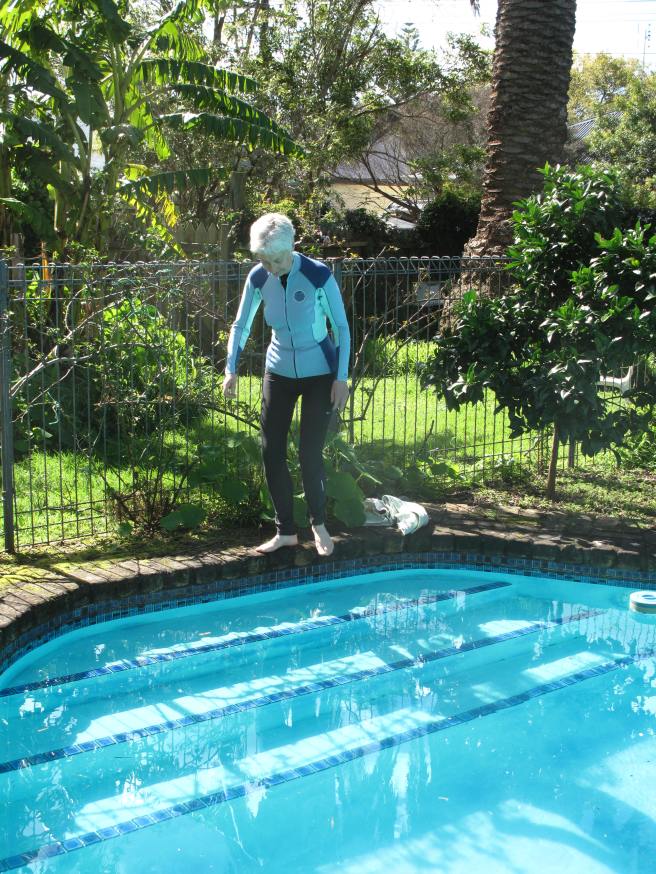
Being a person who gets cold easily I considered buying a wetsuit, but after a trial fitting decided against it. I found the suit so cumbersome to take on and off, and so constricting to wear, that I felt it would detract from the pleasure and benefit of swimming. I got leggings and a neoprene jacket instead and am proud to report that yesterday, the last day of winter, managed to swim one length of the pool …

J contemplating water

Stranger than fiction

Good fortune can come about in the most unexpected ways: coincidence and synchronicity that seem too remarkable to be due to chance, “lucky mistakes” that seem devastating at first but work out for the best. Evidence for a higher intelligence orchestrating our lives, or just random quirks of fate? These examples from my own experience range from the trivial to the life-changing.

The car ferry

Last week we visited the Bay of Islands, some hours’ drive north of our home in Auckland, and took the car ferry between Russell and Opua. I was parked at the front of the side row. Although I thought I had followed the attendant’s guidance, she warned me I was too close to a metal bar on the boat and would probably scrape against it on the way out, because with other cars packed so close I would not be able to reverse. I felt increasingly upset and anxious as the voyage progressed. But then, at the​ end of the crossing, the car next to mine failed to start. The vehicles behind had to reverse to get round it, giving me room to get clear of the obstruction. Meanwhile, shore staff had come on board with jump leads and restarted the stalled car.

The Italian jug

A few years ago, when I was preparing to publish my first novel Carmen’s Roses, I came home to find an unfamiliar jug being washed in the kitchen sink. My husband had picked it up from the pile of rubbish awaiting the annual “inorganic collection” from the pavement of our street. It was white, decorated with swirls of blue and orange, and had Made in Italy written on the bottom. I was delighted and amazed, because a similar jug plays a key part in the plot of my novel, and unknown to my husband I had been searching for a relevant image for the cover. A photo of the jug now features in both the two versions of the cover, on Amazon and Smashwords.

Long-lost family

My last example is more significant. Last year, after my mother died, I felt free to seek information about the father I never knew. A friend with an interest in genealogy posted an online inquiry on my behalf. The synchronicity was that a member of my father’s “other” family was searching the same website at the same time. The lucky mistake was that my friend had got my mother’s name wrong and, for reasons too complicated to explain here, it was only because of this that the connection was made. Though my father himself is long dead, I have since found out about his life, and had successful meetings with my “new” relatives in the UK.


.

Taking tablets

“Healthy living” – good diet, regular exercise, enough sleep, stress reduction, positive outlook – and natural therapies can achieve a lot, but in many cases of medical illness they are not enough on their own. I am thankful to have found effective drugs to control my own episodes of high blood pressure and cardiac arrhythmia. At the same time I can well understand why around 50% of people with chronic disease fail to take some or all of the medication prescribed for them.

There are many reasons for non-compliance (or non-adherence). Side-effects: the experience of unpleasant symptoms in the present, or concern about possible permanent damage in the future. Reluctance to accept a need for ongoing treatment: especially if the benefits cannot be felt immediately, if healthcare professionals have not explained them clearly, or if there is genuine uncertainty about the pros and cons of longterm medication. A desire to avoid artificial chemicals. The financial cost of the drugs.

All these are valid points and there is no doubt that some prescriptions are unnecessary or harmful. But assuming that taking the drugs is indeed the right thing to do, here are some personal observations about how the physical form of the tablets (or pills or capsules) might affect compliance. These aspects may not be considered by the prescribing doctors, though I expect nurses and pharmacists appreciate them more.

Size: while this is partly determined by the chemical makeup of the drug, big tablets are hard to swallow, and small ones can get lost.

Colour and shape: many generic drugs are presented as small round white pills which are hard to tell apart, and this can lead to mistakes in dosage. Coloured tablets of different shapes are much easier to identify. Incidentally, there are some interesting studies showing that the colour of a tablet affects patients’ reports of its effects.

Strength: having to break tablets into halves or quarters is tedious and often inaccurate. Tablet-cutters can help, but it is better if low-dose versions are available.

Frequency of dosage: again this is partly dependent on the properties of the drug, but if it is possible to get a controlled-release preparation to be taken once daily this is preferable to divided dosing.

Such practicalities were not mentioned in my pharmacology course at medical school, as far as I recall. Perhaps they seemed too simple and obvious to be considered in an academic context. I certainly paid them little attention when I practiced as a doctor, not always being aware what the tablets I was prescribing would look like when dispensed. I now realise that size, colour, strength and frequency of dosage can be quite important to patients, especially those who have problems with eyesight or memory. Here in New Zealand it is impossible to get some of the low-strength and controlled release preparations that are available in the UK and elsewhere, and make patients’ lives easier.


Bach flowers: medicine or magic

After taking a few years out from my Bach flower remedy practice due to illness in the family I am now available to see clients again, so it seems timely to revisit the topic on this blog.

The remedies are intended to restore emotional balance. Common presenting problems include anxiety, grief, relationship difficulties, lack of direction in life, and the hardships of physical disease. I am continually impressed with how well the system works: 80 of my first 100 clients reported an improvement, and this figure is in line with the experience of other practitioners. But it is not always easy to reconcile my background in orthodox medicine with my interest in holistic therapies like the Bach flowers. I have to acknowledge there is no accepted scientific explanation for their mode of action, and that when tested in the artificial context of clinical trials they usually perform no better than placebo.

Leaving aside the question of whether the remedies have direct effects, a consultation with a Bach practitioner can be therapeutic because it empowers the client – as the jargon goes – “to take responsibility for their own healing”.  The interview does not follow a set structure, and it is up to the client to decide what they want to talk about and how much detail to reveal. The practitioner listens, and asks questions for clarification, but does not probe for extra information or offer unsolicited advice. The selection of remedies is a cooperative process, with the practitioner making suggestions but the client helping to choose what flowers they need, and sometimes seeing their problems in a new light as a result. The combination of up to six flowers is tailored to the unique individual’s state of mind rather than a symptom or diagnosis.

This is very different from the assessment process used in orthodox medicine and psychiatry. Traditionally, in the orthodox system, the doctor is in charge while the patient takes a passive role. The consultation follows a standard format, with a series of questions followed by examination and investigations, aimed towards establishing a diagnosis. The drugs, surgery or radiation prescribed will usually have evidence-based benefit for the disease concerned, but inevitably carry some risk of side effects. The orthodox approach often works very well, especially for acute conditions and those that are clearly defined, and is sometimes life-saving (as was clearly brought home to me in 2015 when my husband required heart surgery, described in my short memoir Across a Sea of Troubles).

The orthodox approach with its armamentarium of marvellous medical and surgical technology, and the holistic approach which draws on the universal principles of healing and self-help, are truly complementary to each other and can be used together – I think of them as representing the “yin” and “yang” of healthcare. Unfortunately there is considerable antipathy and misunderstanding between practitioners of the two schools and the concept of integrative medicine, which combines the best of both, has not been widely accepted.

While Bach flowers can be used on their own for minor mental or physical imbalances, they are not sufficient as a sole treatment for anything more serious. I often advise clients to seek a medical assessment if they have not done so already because physical diseases, for example over- or under-activity of the thyroid gland which is common especially in women, can present with psychological symptoms.

Clients are attracted to therapies like the Bach flowers because they are natural and safe, treat them as a “whole person” rather than just a case of a particular disease, and provide them with a sense of choice and control.  More information about Bach flowers can be found on this page.

Complementary therapies in cancer care

This short overview is based on a talk I recently gave to the members of Sweet Louise, a New Zealand charity for the support of people with incurable breast cancer.

Complementary therapies can be loosely defined as those not included in orthodox medical training or practice, though this can change, for example acupuncture has been used in pain clinics for many years. Some therapies involve physically touching the body – examples include massage, reflexology, acupuncture. Others involve taking substances by mouth – herbal remedies, homeopathy, flower essences, special diets. Then the mind body therapies such as relaxation, meditation, yoga, visualisation and guided imagery, energy healing. And creative therapies with art, music, writing and dance. Several types can be combined.

They are often known as “natural” therapies, and the same ones may be called “complementary” when used alongside orthodox medical treatments, and “alternative” when used instead. The “integrative” approach combines them both but has been slow to get established, perhaps because of prejudice and misunderstanding on both sides. All these therapies are grounded in the “holistic” approach, which aims to balance the whole person in body, emotions, mind and spirit, and mobilise the potential for self-healing. This is in contrast to the approach of conventional medicine, which uses powerful drugs, surgery or radiation to suppress symptoms and destroy disease, and in which patients have a passive role. Both approaches have their place and can often be used alongside each other.

Surveys show that as many of two thirds of women with breast cancer are using one or more natural therapies, and there is good evidence that they can improve quality of life – helping to relieve physical symptoms such as pain and nausea, mental symptoms such as anxiety and depression, reducing the side-effects of radiotherapy and chemotherapy. They appeal because, in general, they are safe and natural and many of them are pleasant to receive. When I was practising with the Bach flower remedies, many of my clients told me they wanted a therapy that treated them as a unique person, rather than just one more case of a diseased body part.

While all the modalities have specific effects, their benefit is partly due to their positive influence on mind-body relationships. The self-help element, especially with therapies that require some active user participation, enhances a sense of choice and control. Spending time with an understanding therapist in a relaxed setting is comforting. Expectation of improvement can help to bring it about. Such general factors are important, and it is a mistake to devalue them as “just placebo”.

A key question is whether using these therapies can lead to a longer life expectancy or even to remission of the cancer. Many individual cases of remarkable recovery have been reported. But there are few formal research studies on this aspect, and it is a difficult thing to investigate for many reasons – for example treatments are used in individual combinations rather than standard protocols, and patients’ beliefs and motivation affect the outcome.

Some of the therapies carry risks, for example herbal remedies can have adverse interactions with prescribed drugs; massage and acupuncture occasionally cause physical injury. They can be expensive. The field is not tightly regulated and, while most therapists are skilled and honest, there are a few self-styled practitioners who cause more harm than good by making unrealistic promises of curing cancer while advising clients to refuse conventional treatment that would have been effective.

More detail about these topics, with case histories, can be found in some of my non-fiction books.

A writer’s purpose

My writing career has been at a standstill lately, perhaps due to being distracted by various health concerns and family events, and discouraged by a couple of negative reviews. Looking back at my own advice about dealing with writer’s block, taken from my short ebook Wellbeing for Writers:

“Inspiration tends to come in waves. There are times when writers are full of ideas. At other times they may have none, which is always frustrating, and presents a major problem for those who earn their living from writing or have publishing deadlines to meet.

There may be an obvious reason for feeling blocked. I always find myself unable to engage with a new book immediately after finishing the last one, even though I am only really satisfied and happy when I have a writing project underway. I make use of such fallow periods to organise and de-clutter the paperwork in my office and the files on my computer, and to market the book I have just completed.

Some of the other causes for writer’s block, for example striving too hard for perfection, feeling upset about rejection or criticism, adverse experiences in another sphere of life, having too many other things to do, or suffering from a depressive mood swing, are discussed in other chapters.

Besides dealing with any remediable underlying causes, there are various strategies for overcoming writer’s block. If circumstances permit it can be a good idea to take a complete break from writing, and do something else for a day or two or even much longer. Preferably this will involve activities, people and places completely different from those encountered in your usual routine, which may provide new ideas. Other forms of creativity, such as painting or dancing, can help.

The opposite approach is to discipline yourself to keep on writing for a set period each day, but again try doing it with a new approach. Clear the clutter from your desk to encourage a fresh start. Write a short and simple piece instead of attempting the major work on which you feel stuck. Some authorities suggest inducing a relaxed state with deep breathing or slow music and then using your non-dominant hand to write something – anything – which even if it turns out to be nonsense may still stimulate the creative flow. Or try writing late at night or early in the morning, when you are half-asleep and more able to access the reservoir of images and memories in the subconscious mind.

Getting started again often presents the biggest barrier, and if you can get past that it will usually be much easier to continue.”

Fair enough, but I also find myself asking what is the point of writing at all? This is what I said in Wellbeing for Writers:

“The most fundamental and compelling motive for writing is for the sheer love of it. Some people feel they were born to write, in the same way that others know from early childhood that they were born to climb mountains, to heal the sick, to do scientific research or to make music. Writing is their vocation, destiny or soul’s purpose; the one activity which brings them ‘into the flow’ and if they are prevented from doing it they will feel frustrated and unfulfilled.

Even if you do not feel quite such a passionate commitment, you may find that writing brings other personal benefits. These could include making sense of your life experiences and challenges, expressing emotion, exploring new subjects, exercising your intellect, or feeling that you are creating something original to form a lasting legacy of your time on Earth.

These inner rewards of writing can be seen as doubly important when you consider that it takes long hours of solitary work to complete a book, and that the fate of the eventual product is unpredictable. Finishing your book, getting it published, receiving positive responses from readers, and receiving royalty payments are all worthwhile outcomes and not to be devalued. But not all writers will achieve these goals. Some books are never finished; others do get finished but are never published; many of those that do get published are seldom read or reviewed; and few authors make a good living from their royalties. The market is currently supersaturated with self-published books many of which, however good they are, will be overlooked. So it is highly desirable for the actual process of writing to be perceived as satisfying and worthwhile. In other words it is just as important to enjoy the journey as to reach the destination.”

I hope my inspiration for writing will return again soon. Meanwhile, remembering what I put in the section on writers’ health, it is better to spend time walking outdoors in the bright sunshine of the New Zealand winter than sitting down at the computer.

cover-w4w