Feline heartaches

I couldn’t stop crying when the time came to take our latest foster kitten, Nico, back to the rescue centre. We have fostered many kittens before and I have never been seriously upset about saying goodbye to them. Indeed it has been rewarding to see them grow in health and confidence while in our care, and be passed as ready for adoption. But Nico was somehow different.

He came to us at four months old, an unremarkable-looking tabby kitten, very thin because he had been suffering from bowel infections and presumably been malnourished in earlier life. He thrived while he was here, and quickly made himself at home, being let out of the foster room during the day if I was there to supervise him. He was energetic, playful and affectionate and he won our hearts.

We have two cats of our own, both 10 years old now. Leo, the male tabby, made friends with Nico right away. He enjoyed grooming him, and the two of them ate side by side.
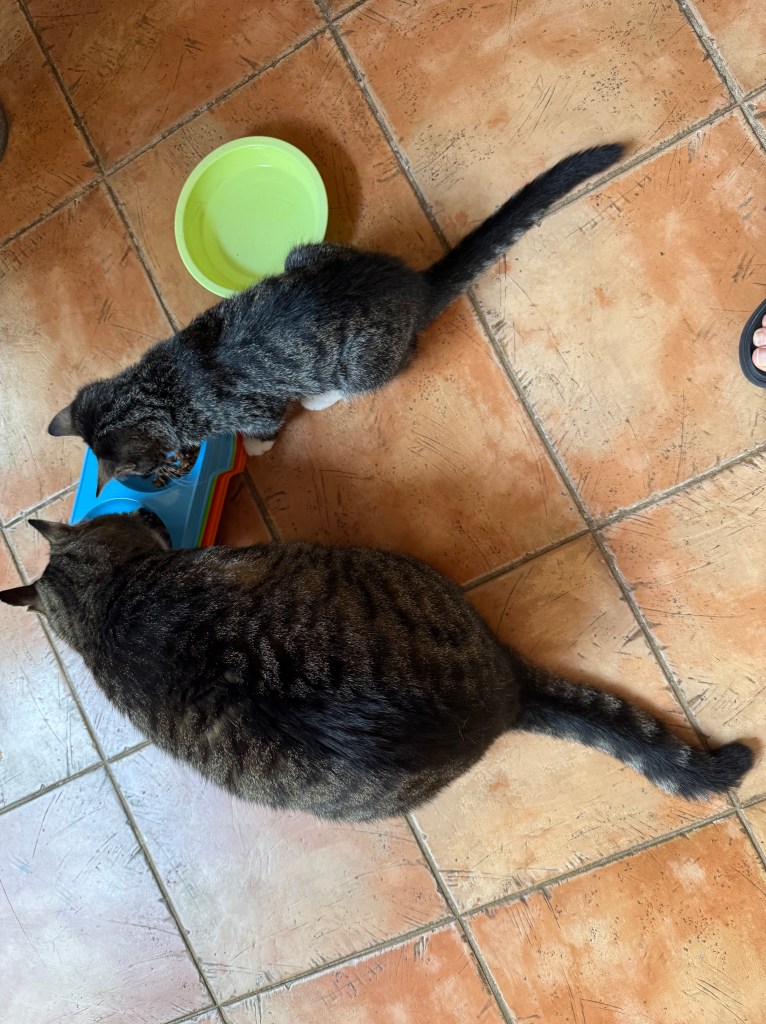
Leo and Nico

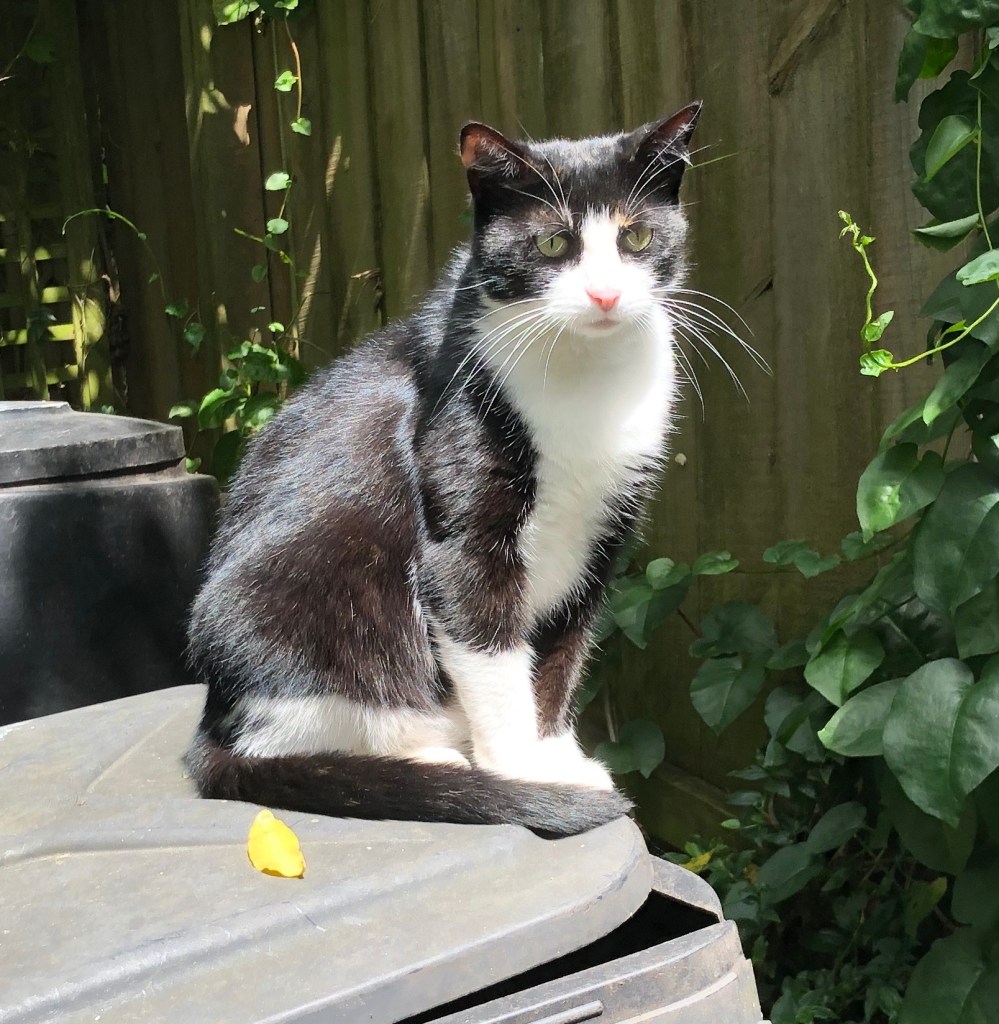
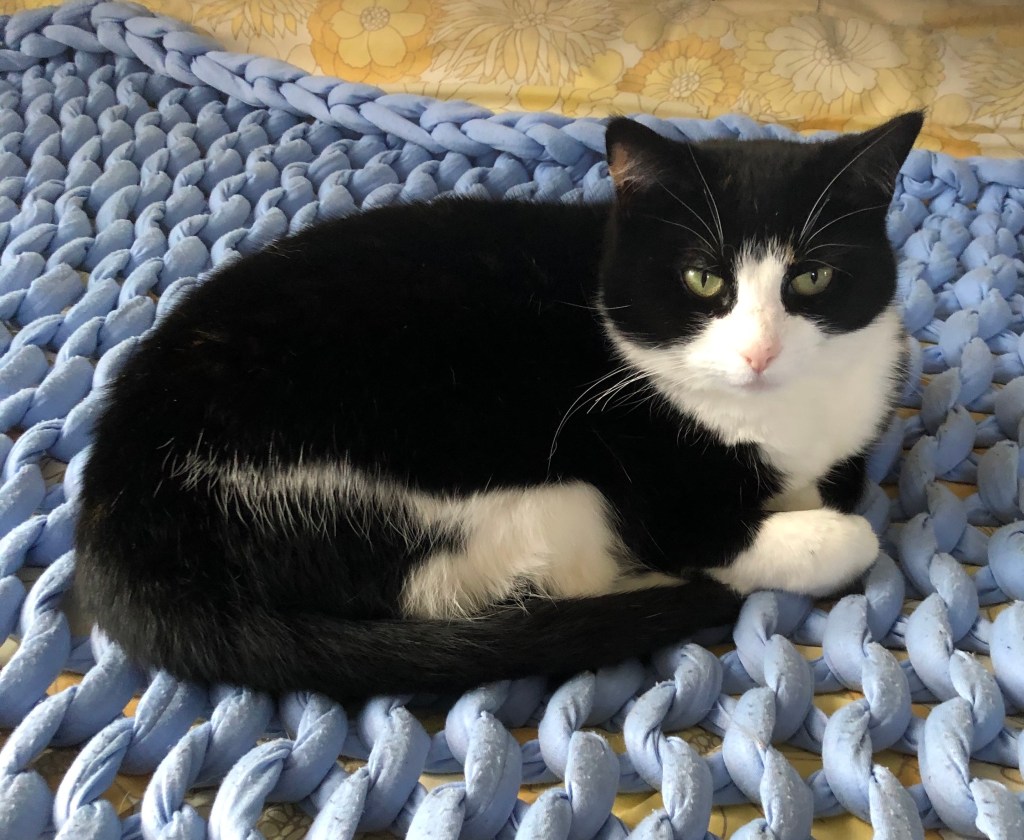
But Magic, our black and white female, reacted quite differently. She always knows when there are kittens here even when they are shut away in the foster room, and leaves the house for long periods, refusing to eat unless her meals are served outside. It has been worse this year and she has been completely absent from the property at times.

My husband Brian doesn’t usually get involved with the foster kittens, but he took to Nico so strongly that he suggested adopting him. We had long discussions about this. I wanted it too, because I had become so fond of Nico.But logically I knew it would be a mistake. I think we are too old to take on a young kitten who is likely to outlive us. Looking after three cats is a big commitment and expense. And a major barrier would be Magic’s mental health. Even now that Nico has been gone for several days, and I have given the foster room a thorough clean, she is reluctant to come into the house again. Al least she was back in our garden today, but didn’t take kindly to having her photo taken. “No good deed goes unpunished”, and by caring for foster kittens I have caused much heartache for Magic.

Magic

Fostering is a lot of work and after doing it for a month, first for the two timid kittens and then for Nico, I am glad to have a rest and be free for other things. But I still miss Nico very much and do hope that he, along with all the many other cats and kittens currently in the shelter, will find the right forever home.  

Update 5 days later: Nico has been adopted, and Magic has returned home.
Kitten season

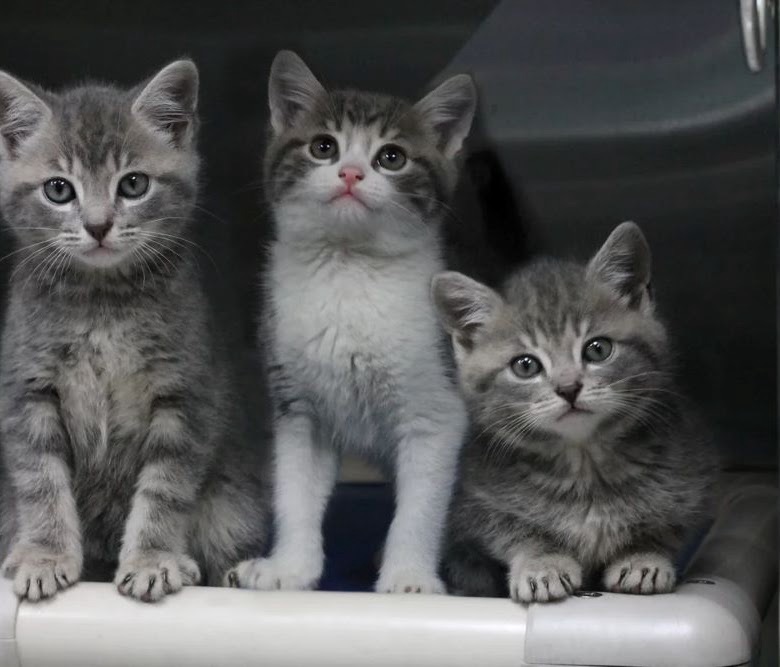
Photo courtesy of SPCA Auckland

Every year during January, I volunteer to foster kittens from the SPCA. I clear the best furniture out of the dining room, which for the next few weeks becomes known as the foster room, filled with feeding bowls, litter trays, climbing frame and cat toys.

Kittens may require fostering for a variety of reasons. Some are healthy but still too young to be desexed and vaccinated prior to being adopted into forever homes. Some are recovering from an injury, or from illnesses such as cat flu and giardia. Others are frightened of human contact because they have been neglected or abused, and need a period of socialisation. And this year there are so many cats and kittens being brought in that the rescue centre is full to capacity, meaning that some animals need accommodating in private homes.

My current charges, a brother and sister about nine weeks old, were on anti-anxiety medication when they arrived. They were extremely timid, hiding in inaccessible places for much of the time, and it was very difficult to touch them. What a contrast to my previous kittens who have been desperate to escape from the foster room and explore. They did however seem physically healthy, eating and drinking well and have grown fast. Their confidence has gradually improved and now, two weeks later, they are lively and playful and purr loudly when stroked. I’m not allowed to post photos of them online, but they do look very attractive, with their white and tabby coats. It has been lovely to watch their transformation from frightened little kittens into thriving young cats.

Fostering requires quite a lot of time and effort. The least pleasant aspects are having to keep changing litter trays throughout the day, and the potential for damage such as torn curtains. It is also a bit hard on one of my own cats, who clearly dislikes having kittens in the house even though they are in a separate room. My other cat is quite happy to have them here.

These two kittens will be returning to the SPCA in a few days and will hopefully be adopted soon. I will miss them, but am going to exchange them for another litter which will bring new challenges and rewards.

Too many photos

Since buying my first iPhone I have taken thousands of photos, which have been stored rather haphazardly in various locations on my computer, some identified only by their numbers. I recently resolved to declutter and reorganise my digital files, prior to updating my devices. Labelling all the photos and allocating them to folders has proved a massive task, made harder because of my somewhat obsessional nature. How to classify them? Some belong in more than one category – animals, husband, family, friends, holidays, me with different hairstyles. Which to keep? I don’t like deleting any, apart from a few duplicates and photos of people I no longer recognise.

The project – still not quite finished – has sometimes felt overwhelming. For a while I was rushing to get it done, and wishing I hadn’t started it at all. But it seemed too late to give up, so I resolved to take a more thoughtful approach and appreciate all the images for the happy or sad memories they evoked.

Doing this has been a poignant reminder of the transience of life. Many of the people and animals in the photos have now died. The appearance of myself and my husband has changed over the years, and not for the better. I may never want to look back at these files again myself, and I have no close family so nobody else will want to keep them after my death. Anyway, they might all have been wiped out by some technical disaster by then. I was reminded of the Tibetan Buddhist monks who create beautiful mandalas made of coloured sands, and then deliberately destroy them.

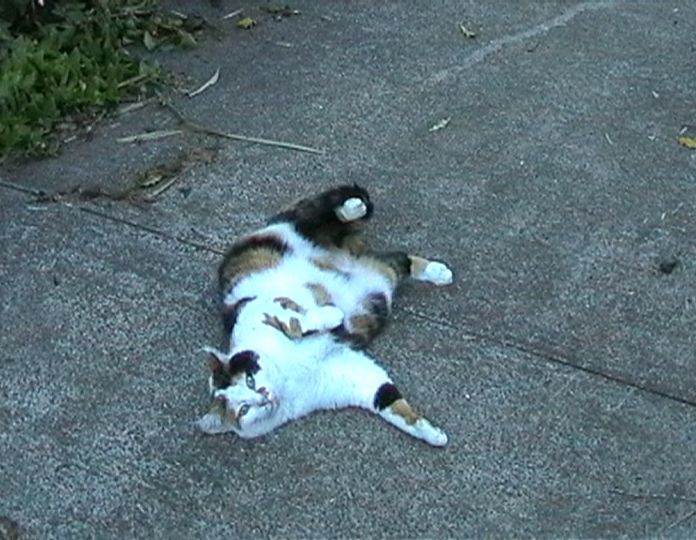
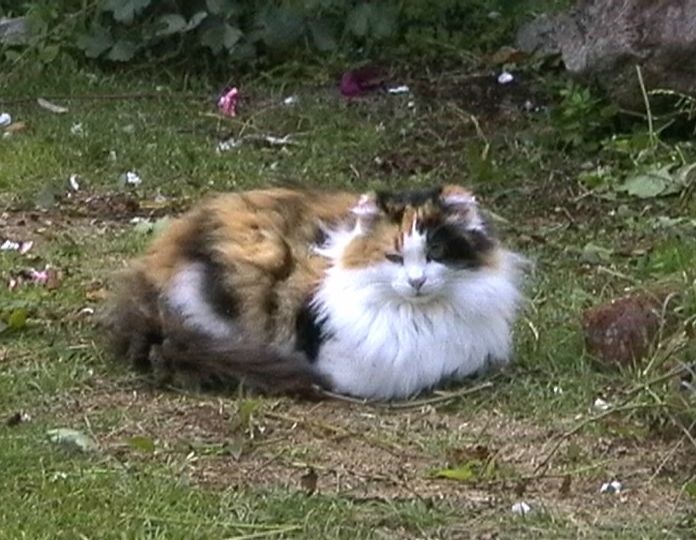
Only read on if you like cats. I usually include some photos in my posts, but couldn’t decide which to choose from among so many, so I decided just to feature the cats who have lived with us since we moved to New Zealand. Excluding all the foster kittens, there have been seven long term residents, two of whom – Magic and Leo – are still alive. It was quick and easy to find their photos, which made me think that the project has been worthwhile after all.

Cinderella
Floella (daughter of Cinderella)
Felix
Daisy
Homer
Magic
Leo

Don’t pat strange dogs – Updated

While out and about I always say hello to the dogs I meet, and most of them want to be friendly. I have patted hundreds of them over the years, and never been bitten – until last week. I was walking past a cafe where a medium sized black dog was sitting with his family at an outside table. Our eyes met. I began to approach him, assuming he wanted a pat, but he suddenly lunged forward and sank his teeth into my hand. It was a deep bite and very painful. I went into shock and almost fainted. The dog’s devastated owner and the cafe staff were very helpful, bringing me water and putting iodine and a plaster on the wound. After a while I felt well enough to continue on my way.

The pain continued all day, and by next morning my whole hand was red and swollen. My husband came with me to the emergency department of our local hospital. I was seen by a specialist nurse who gave me a tetanus booster and some blood tests, arranged for a hand X-Ray and admission to the orthopaedic ward.

The ward was full, so I spent the first day receiving my intravenous antibiotics in the corridor of a crowded and noisy medical assessment unit. I was transferred to a spare bed in a gynaecology assessment unit overnight, and finally reached the orthopaedic ward before lunchtime next day. This was not ideal but the important thing was having been promptly started on treatment, without which I realise I could have lost an arm or even died.

Being in hospital was a new experience for me and not nearly so bad as I expected. All the staff I encountered were skilled, efficient and kind. It was interesting to chat to other patients, and good to receive visits and messages from family and friends. I felt surprisingly well during my stay but it was a while before the cellulitis began to resolve. I was scheduled for surgical drainage on the third day, but by then the operation was judged to be unnecessary and I was discharged home to continue on oral medication for another week.

Dogs usually bite because they feel threatened, and it is those who have been abused as puppies who are more likely to become aggressive in later life. The owner has kept in touch and I hope to meet him again to find out something about the culprit’s background and character, and try to understand why I provoked him. I will be more cautious in future about patting strange dogs.

Update March 2024

Three months after the events described above, I arranged to have coffee – in a different café – with the family of the dog that bit me. As I suspected, Baxter (not his real name) had been cruelly treated in early life, during that vital period from about 8-16 weeks which can make or mar a dog’s temperament. He was born overseas in a puppy mill, transported long distances, and surrendered to a rescue centre before being adopted by his present owners. Even after some years in a loving forever home, he still has some behaviour problems, and is now having professional therapy. When I saw him at a distance he regarded me suspiciously. I have let go of any fantasies about making friends with Baxter, but seeing him and his family again gave me a worthwhile sense of “closure”, and I wish them well on the long journey of rehabilitation for a dog who has been so damaged by early abuse. By the way my hand wounds have healed well, leaving just a tiny scar to remind me of what happened. 

Bottle babies: feline neonatal care

I have fostered many homeless kittens over the years, but none less than 10 weeks old. I recently attended a workshop at my local animal rescue centre to learn about fostering neonates. These have usually been brought in by members of the public who have found an abandoned litter without a mother cat. Caring for these orphaned newborns is a full-time job requiring great dedication, as they need attention every 2 hours both day and night if they are to survive. After arrival at the centre they are allocated to a foster parent who can pick them up as soon as possible and take them home along with all the necessary equipment: carry cage, towels and bedding, microwavable heat pad, formula feed, bottle and teats, digital scale and bowl for weighing, syringes and toileting cloths.

Photo by Sam Paeez on Unsplash

The care routine, as demonstrated on a stuffed toy at the workshop, involves preparation and warming of formula food, hand washing, toileting, weighing, bottle feeding, toileting again, cleaning, burping, changing the bedding, cleaning the bottle, hand washing again, and recording notes to send in to the centre. The process is then repeated for the next kitten. It is best for each foster home to have more than one, so they can learn to socialise and play with each other.

They will spend the first 3 weeks in their cage, then at 3-5 weeks move into a larger crate, and then when they have learned to feed themselves and use a litter tray they have access to a small secure room but are not allowed outside. When they can eat solid food and have reached about 1 kg in weight, usually at 8-10 weeks of age, they return to the centre to be desexed, microchipped and vaccinated. Some will need a further few weeks of fostering, for example if they are still on medical treatment. They are then ready to go to their forever homes. Kittens at this stage are very appealing and are usually adopted within a few days of becoming available. Sometimes the foster parents can’t bear to part with them, as was the case with Magic and Leo (pictured) whom we decided to keep after fostering them 8 or 9 years ago.

Leo

Things do not always go smoothly. Small kittens from deprived backgrounds are vulnerable to infections such as cat flu, ringworm and Giardia. For this reason they need to be checked daily for symptoms such as lethargy, loss of appetite, diarrhoea, vomiting, sneezing, discharge from eyes or nose, scratching or hair loss. They also need to return to the centre once a week to be examined by a vet. Not all of them will survive, sometimes due to a condition called the fading kitten syndrome, which can develop for many reasons though often the cause is unknown. One friend of mine has questioned the wisdom of putting so much effort into saving their lives, when there are so many unwanted cats in New Zealand. But it would seem very hard hearted to let them die. A better solution to overpopulation is desexing, which is now being stepped up again having been suspended during the Covid pandemic.

Maybe reading this post will encourage others to consider neonatal fostering, After reflecting on the content of the workshop, I don’t think I have enough physical or mental stamina for the night work involved in looking after “bottle babies”, but I look forward to taking in some slightly older kittens again this summer.

Learning the piano – with cats

Daisy was a major distraction

I am resuming my efforts to learn the piano. I doubt I will ever achieve my ideal of playing Bach with fluency, but it would be nice to be good enough to play simple pieces for my own pleasure. Also, having reached an age when an alarming number of my friends are developing dementia, I hope it will help to preserve my brain power. Studies have shown that playing the piano improves memory, mental speed, concentration, and eye-hand coordination, as well as decreasing anxiety and boosting happiness and self-esteem.

As a child I had a few lessons which I didn’t enjoy, though I was glad of them when I started playing again after a gap of several decades and found I still remembered some basics which might have been hard to learn later on. I know it is important to have a teacher to encourage regular practice and progress along the right lines, but it can be hard to find a good one. I have had a couple who were mediocre, and one who verged on the sadistic – I imagine it must be frustrating for skilled musicians to have to earn a living by giving lessons to slow learners like myself. My most recent teacher was excellent but he is no longer available and will be hard to replace.

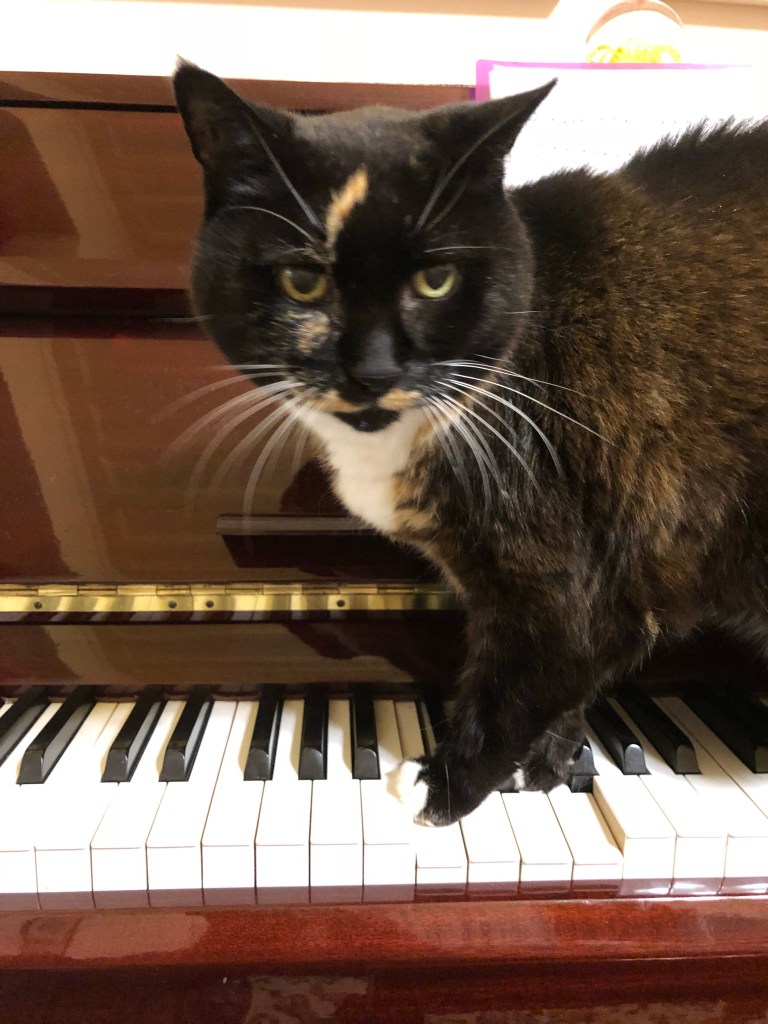
I have some excuses for failing to practise as much as I should. A major setback was breaking my wrist and being unable to play at all for almost a year. Movement of my right hand is permanently restricted, and it becomes painful if I use it for too long. The other main impediment is the presence of cats. When Daisy (pictured) was alive, she delighted in jumping onto the keyboard and marching up and down, with a preference for the bass. I sometimes wish I could have trained her to play proper duets with me, after the fashion of Nora the Piano Cat whose YouTube videos have brought her worldwide fame. Nora is a grey tabby, adopted as a kitten from a rescue centre and now almost 18 years old – a feline example of the health benefits of playing the piano? One of our present cats, Leo, distracts me by scratching rhythmically on some nearby piece of furniture whenever I start to play. Our other cat, Magic, has no interest in music at all.

Jumping for joy

Ireland the Labrador greets me by jumping high in the air whenever I come to take him for a walk.

The two of us met about six years ago through The Dogshare Collective. One of his human family had suffered an injury at that time and needed help with his care. I started taking him out in the afternoons, and continued doing so long after his owner’s injury had recovered.

Ireland was bred to become a guide dog for the blind, but due to a minor defect in his own vision he was withdrawn from training and made available for adoption as a family pet. Large, friendly and exuberant, he loves playing with other dogs and like most Labradors he has an insatiable appetite. We have enjoyed many outings and adventures together (search the Animals section of my website to see illustrated posts about my walks with Ireland, also with my other dog share Buddy).

Having a dog brings great benefits – physical, mental and social – also involves great responsibilities. There are many people who are not in a position to have a dog of their own but would like to have a relationship with one. And there are many dogs who, often because their owners are out at work all day, need additional exercise and company. Within New Zealand The Dogshare Collective exists to put people from these two groups in contact with one another.

Animal exports; a moral dilemma

A ban on the export of live cattle, sheep, goats and deer from New Zealand will come into force this month, following years of campaigning by the SPCA backed by widespread public support. But we are having a general election in October 2023, and the National and Act parties have stated that if they come into power, live animal exports will be started again.

This practice is both cruel and unnecessary. A position statement from the SPCA has described the stressors on animals undergoing sea voyages lasting weeks or months: fear and anxiety, exposure to disease, overcrowding, overheating, motion sickness and more. Some animals die on board, and in 2020 almost 6,000 drowned when a livestock container ship en route from New Zealand to Saudi Arabia sank off the coast of Japan. And, depending on the adequacy of health and welfare in the destination countries, animals may be subjected to further suffering when they arrive.

There are alternatives to live export. Animals for food could be slaughtered here and their refrigerated carcasses exported. For breeding purposes, semen and embryos rather than live animals can be used.

This issue presents me with a moral dilemma. I don’t want to see the Labour Party returned again; since they have been in government New Zealand has gone backwards with falling standards in healthcare and education, increased poverty and crime, increased racial divisions, billions of dollars wasted on idealistic projects which have never been completed. Until now I had been firmly intending to vote for either National or Act, but how can I justify supporting a party which will reinstate live animal exports? Several letters published in the NZ Herald newspaper, including one from me, have expressed this dilemma. I have written to the party leaders, and my local MP, to protest the policy and I hope that if enough other people do the same they will revoke it. If not, is the only answer not to vote at all?

Two dogs

Although I don’t have my own dog, I have the pleasure of knowing several local ones, and regular “dog sharing” arrangements with two of them: Ireland the Labrador and Buddy the Cavoodle. This involves taking them for walks, and sometimes keeping them company while their owners are out. I love both dogs equally, but they are so different from one another it can be hard to believe they belong to the same species, canis lupus familiaris.

Ireland the Labrador

Ireland is a confident, exuberant big black Labrador nearly six years old. He loves everything life has to offer: going for walks, playing with other dogs, riding in cars, and most of all he loves eating – almost anything except kidneys. His only fault is a tendency to bolt towards any source of food, such as a picnic or a discarded pie, which he can smell from far away. I have been walking him for about four years now and his joyful greeting when I come to see him always makes my day.

Buddy the Cavoodle

Buddy, a second generation Cavoodle just coming up to his first birthday, is a more sensitive soul and prone to anxiety even though he has been raised with the utmost kindness. He is gradually becoming more confident, and now enjoys going for walks although he was previously reluctant to leave the house. He still hates car travel, and in further contrast with Ireland he is indifferent to food, and often has to be coaxed into eating. Buddy is a very handsome dog, with an affectionate nature. He loves cuddles and is still small enough to sit on my lap.

The characteristics of Ireland and Buddy are typical of their respective breeds. For example it is well established that Labradors are obsessed with food, and that Cavoodles are prone to separation anxiety. Although the way that dogs are treated and trained has a big influence on their development, research has shown a clear genetic basis for inter-breed differences in personality, behaviour and intelligence. https://theconversation.com/genetic-research-confirms-your-dogs-breed-influences-its-personality-but-so-do-you-196274. Doing similar research on humans would be considered racist and unethical nowadays.

Buddy the beautiful Cavoodle

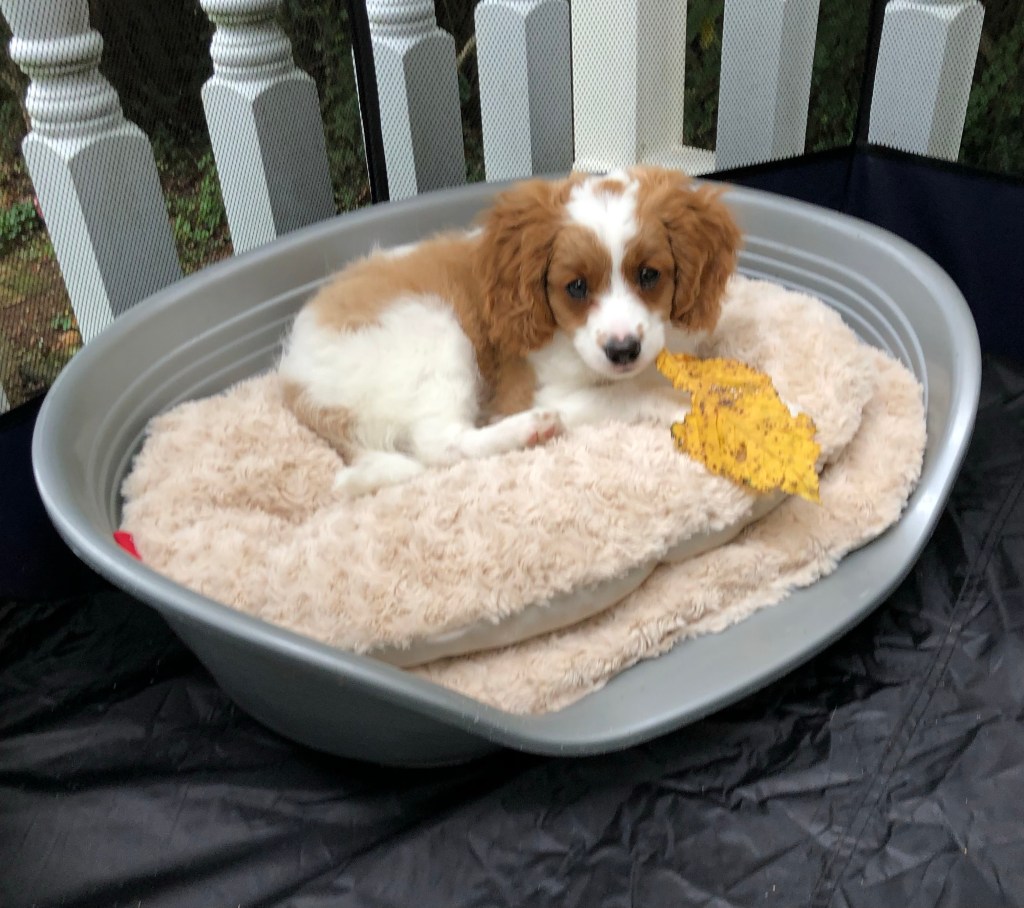
Buddy aged 8 weeks

I’ve just met my new dogshare puppy, Buddy. I will be helping to look after him on days when his owner cannot take him to work. He is a lively, cuddly and confident little pup and I fell in love with him at first sight.

A Cavoodle is a cross between a Cavalier King Charles Spaniel and a toy or medium Poodle. Such dogs, weighing 4-12 kg, are said to be very affectionate, energetic and intelligent. Apparently they love human company, being prone to separation anxiety when alone; are not especially keen on food (what a contrast to my Labrador dogshare, Ireland); and are good swimmers.

Buddy is a 2nd generation cross, from two Cavoodle parents, and through the genetic lottery appears to be more Spaniel than Poodle. He looks very like a Blenheim Cavalier King Charles Spaniel – chestnut and white, with a “Blenheim spot” on the top of his head. According to the Wikipedia site about that breed: “The Blenheim spot is also known as the mark of the Duchess Thumb Print, based on the legend that Sarah Churchill, Duchess of Marlborough, while awaiting news of her husband’s safe return from the Battle of Blenheim, pressed the head of an expecting dam with her thumb, resulting in five puppies bearing the lucky mark after news that the battle had been won.”

Buddy aged 9.5 weeks

Dogsharing involves dividing both the joys and responsibilities of dog ownership between households, in a flexible way arranged on an individual basis, for the benefit of both the humans and animals concerned. Within New Zealand, matches can be arranged through the Dogshare Collective.