Homer: the odyssey continues

The adventures of the white-and-black cat described in my recent post Homer’s story still continue.

After my mother died Homer never gave up his attachment to her house, and although he did move in with us part-time, he started visiting the young couple who were renting next door to my mother. They became very fond of him, and when they bought a house of their own in Bayswater we agreed to a trial adoption.

We had Homer microchipped in case he went wandering again, although considering that six years had passed since he made his repeated journeys from Bayswater to Devonport, we hoped he would have outgrown his wanderlust.

I visited Homer and his new owners every week and we did everything we could to help him settle into his new home. All went well for a month, but on the first night after a cat door was fitted, he exited through it and turned up in Devonport – over 3 km away – next morning. After some tearful discussions we agreed that Homer had should be allowed to stay in the area he loves so much.

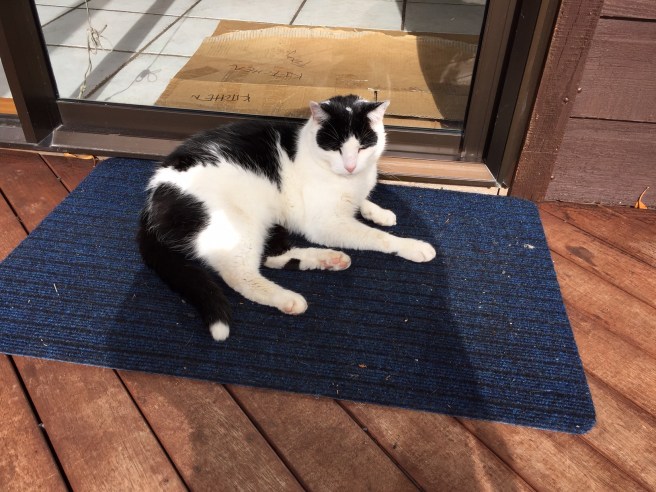
Fortunately, the new couple who are renting next door have also become fond of Homer, and are giving him food. He still likes to spend time around my mother’s vacant house, lying on the doormat as illustrated below. Last week he became obviously distressed when her furniture was being cleared out. But the new owners move in next week and I understand they are cat-lovers too, so I hope Homer will get on well with their two kittens, and that having meals available from three different houses won’t make him get too fat.

Homer on mat


A giveaway backfires

I recently gifted a print copy of my novel Fatal Feverfew to the winner of my latest Goodreads Giveaway. Soon afterwards she posted a rating on the website, giving it 1 star and commenting “the writing was dull, the plot was poorly written, and the characters were extremely unlikeable and boring. I really struggled to finish this book.”

In my younger days I would have been depressed for weeks after reading a review like that. Now I am more philosophical, reminding myself that you can’t please all of the people all of the time. All the previous novels that I put through the giveaway programme received 4 or 5 star ratings, and I can’t believe this latest one is so much worse than the rest. I do wonder whether someone who has to “struggle to finish a book” would do better to abandon it and move on to something they enjoy reading – this is my own policy now, and I don’t write a review unless I can say something positive.

So, my latest giveaway has backfired as a marketing method – or has it? A day or two after that damning review was published, a little peak in sales of both Fatal Feverfew and some of my other books showed up online. Maybe this proves the truth of the saying that there’s no such thing as bad publicity.

Here are some suggestions about how to cope with bad reviews.

Stress and the heart

Although I used to work as a general hospital psychiatrist, I doubt if I fully appreciated the power of the mind-body connection till I became ill myself. Last year, during a prolonged period of anxiety and exhaustion due to my husband’s heart attack and cardiac surgery followed by my mother’s bowel obstruction and fatal stroke, I started to experience alarming episodes of fast irregular heartbeat, faintness and tightness in the chest, accompanied by high blood pressure. Other symptoms around this time included weight loss, insomnia, spells of fatigue, hot flushes and cold chills. Medical investigations showed a few minor abnormalities which were not regarded as very significant.

The episodes of tachycardia and hypertension continued to happen after everything else had settled down, as if they had taken on a life of their own. My husband, who has now made an excellent recovery himself, believes that being in the “front line” of so many traumatic events caused me to develop a variant of the condition described in the First World War as “shell shock” or “soldier’s heart”. Many other diagnostic labels were suggested from various sources: “broken heart syndrome” “post-traumatic stress disorder” “atypical depression” “autonomic neuropathy”. The diagnosis from a recent specialist consultation was “paroxysmal hypertension” also known as “pseudopheochromocytoma” and preventive treatment with beta-blocking and alpha-blocking drugs has been successful so far. From being barely able to cope with daily activities a few months ago I am now almost back to my usual self, but with an increased awareness of the fragility of life and health and the unpredictability of the future.

While the type of stress-related syndrome described above is not life-threatening, there are more serious cardiovascular conditions that can be partly attributed to stress. I am not an expert in “psychocardiology”, but my experiences led me to look through the research literature and I found some well-established links. These probably stem from a complex interplay between biological and lifestyle factors: over-secretion of stress hormones such as adrenaline and cortisol, and lifestyle habits such as smoking, drinking too much alcohol, lack of exercise, lack of sleep, and general neglect of self-care. For example: Coronary heart disease, building up gradually over the years, is associated not only with the well-known physical risk factors such as hypertension and high cholesterol but with psychosocial ones: long term difficulties such as being unemployed, lonely, unhappy in marriage or at work, suffering from anxiety or depression and according to some studies the personality characteristics of impatience, competitiveness, hostility and suppression of emotion. Acute traumatic events, such as experiencing the death of a loved one or being involved in an accident, can precipitate angina, arrhythmias or heart attacks (myocardial infarction caused by coronary artery blockage) in predisposed people. The risk of death from heart disease  is increased during the first year of widow(er)hood. Those who survive a heart attack, and become anxious and depressed afterwards, have a worse medical prognosis than patients whose mental health is not so affected.

Mind-body connections, though widely accepted in theory, do not always have much impact on clinical practice. It is perhaps inevitable that, in the highly specialised world of hospital medicine and surgery, there tends to be a narrow focus on the diseased part rather than a more holistic view. Staff who are expert in technological procedures may not have the time or skill to deal with the lifestyle and psychological aspects of illness, for example many cases of depression and anxiety on cardiology wards are not recognised or treated.

Most cultures regard the heart as the seat of emotion, and in the energy medicine traditions of the East the “heart chakra” is associated with love, compassion, empathy and forgiveness. Can cultivating such qualities protect against heart disease? Not only are they difficult to measure, but most studies in medicine and psychology focus on negative factors rather than positive ones. However, there is evidence that life satisfaction, optimism, and happiness lower the risk. Owning a dog, which besides encouraging regular exercise provides a reliable source of unconditional love, is also conducive to heart health. Cats apparently have less cardioprotective effect, but they do know how to demonstrate the art of relaxation.

Homer supine


Bonnie the family dog

Nine months have passed since the last time I walked on Takapuna beach with my mother and Khymer. After both of them died I had good intentions of continuing the regular walks, in their memory, and for the health benefits of “earthing” barefoot on the sand. It wasn’t so much fun on my own and I soon gave up doing it.

But now Khymer’s family have a new puppy. Bonnie is a rescue dog, pedigree unknown, though pointer is certainly part of the mix. She is affectionate and intelligent and already, at about five months old, has learned to obey several commands.

Accompanied by our niece Libby, I walked Bonnie for the first time today. She enjoyed chasing seagulls, retrieving her ball, playing with other dogs and splashing about in the waves. No dog can replace Khymer, but the circle of life continues and the bond with Bonnie will grow. I hope to be walking her for many years to come.

Bonnie 5 months old

Reflections on self-publishing from Margaret River

I spent last weekend in Margaret River, a small town south of Perth in Western Australia, at an informal reunion meeting for doctors from Oxford UK who now live in the Antipodes. Besides visiting some local vineyards, beaches, and limestone caves, most of us gave short talks to the group. Mine was on a non-medical topic – a basic overview of self-publishing. The content was not specific to doctors, but relevant to aspiring “indie authors” from any profession, so I’ll summarise it here.

First a brief personal background. Back in the 80s and 90s it was easy enough to find a traditional publisher for books about my medical specialty. I wrote or edited eight titles for academic publishers in the UK, and was sometimes even invited to produce new ones. It therefore came as a humiliating shock when my first novel was met with a series of rejection letters – some polite and encouraging but others not. After a particularly painful rebuff I gave up for many years. Then, when the self-publishing movement came on stream, I retrieved my faded typewritten manuscripts from the boxes where they had languished for so long and started revising them, as well as writing new ones. I have now become an indie author with eight titles to date, published as print-on-demand (POD) versions with Amazon CreateSpace, and as e-books on Smashwords and Amazon Kindle.

While so-called “vanity publishing” used to be expensive and stigmatized, now in the digital age self-publishing has become acceptable and affordable. So much so that everyone seems to be doing it – thousands of new books are self-published every day. A few, most famously Fifty Shades of Grey, are highly successful but most sell only a few copies. Those who embark on indie authorship in the hope of financial profit are therefore likely to be disappointed but there are many other rewards, as well as some potential pitfalls.

Besides writing the best possible content, indie authors have to deal with all the other aspects of the publishing process, although rather than do everything yourself you can employ some of the many freelance experts who can be found online. Editing and copy-editing are essential and I would strongly recommend that besides carefully checking the text yourself you ask several other people, whether professionals or honest friends, to point out the typos and mistakes in continuity that are almost always present. Formatting the text properly requires some technical expertise, and while some self-publishing platforms will accept whatever is submitted to them, others have strict formatting requirements. Uploading the completed text from a PC or Mac to your chosen online platform(s) is usually easy to do.

The following points are relevant for marketing purposes. Cover design is important because a split-second glance at the thumbnail image is often the basis on which potential readers will decide whether or not to “look inside” the book. Writing an enticing blurb, and choosing the most suitable categories and key words, will also help to attract readers. As regards pricing, the option of offering your e-books free of charge is undoubtedly the best way to obtain plenty of downloads but, unless your motive is to inform and uplift your readers rather than make a profit, giving away any more than a 20% sample would seem to devalue all the work which goes into their creation.

Self-publishing has both pros and cons when contrasted with the traditional route. Indie authors are assured of publication and have the freedom to control most aspects of the process. They have the flexibility to write books of almost any length, in any category or cross-genre. Publication can be complete in a few days or even a few hours. POD books and e-books need never go out of print or be remaindered. But the process is perhaps too easy, and the downside is that lack of independent quality control has led to a glut of mediocre books, meaning that many of the good ones are overlooked, and downgrading the status of indie authorship.

Many indie authors would say that having to handle their own marketing is the hardest and least enjoyable part of their work. They prefer to spend their time and energy on actual writing; feel diffident about promoting themselves; and be unsure how to go about it. But it has to be done and there are numerous methods available, for example:

Family and friends: tell your personal contacts about your book, and invite them to pass the information to their own circles. Some will be supportive, but others will not be interested to read it, or may not like it if they do.

Email signature: add a link to the book’s website to your personal email signature.

Social media: such as Facebook, Twitter and Linkedin.

Newsletter: hosted by a service such as Mailchimp.

Blog: the content does not have to relate directly to the book – someone who recently read my blog about cats emailed to tell me that she went on to buy a few of my medical titles.

Reviews: send free copies to selected book bloggers and media, but be aware they are overwhelmed with requests and may not respond.

Author pages: set up a profile on Amazon and other platforms.

Printed fliers or bookmarks: to give away at events, or through local libraries or cafes.

Presentations to groups

Online forums: discussion groups, such as those on Linkedin, relating to writing and/or to the subject-matter of your book.

Paid adverts and publicity campaigns: though expensive, these are not always effective.

Luck undoubtedly plays a part in determining which of the books in this supersaturated market will succeed in terms of sales. But even if you do not sell many copies it is satisfying to have your finished product “out there” and to have learned some new skills along the way.

This was quite a long post, but has only provided a highly condensed overview of the self-publishing process. More detail of my own take on how to enjoy being an indie author can be found in my short e-book Wellbeing for Writers.

Cover W4W

Decluttering after a death

Dealing with the aftermath of a death in the family is a long and arduous process. Many kind people are helping me to sort through the contents of my late mother’s house, yet there are many aspects of the task which I must deal with myself rather than delegate. It feels overwhelming at times, and brings up an uncomfortable mix of emotions.

Having been brought up in frugal wartime Britain, my mother seldom threw anything away. When she came to live in New Zealand she brought a container load of possessions. Some of the household items – furniture, bedlinen, crockery and cutlery, ornaments – belonged to my grandparents. She also brought large supplies of clothing, numerous boxes of papers mostly relating to her former academic career, and her precious library of books. It feels heartless to be discarding things which carry so many memories both of her life and mine. But I know it is best that most of them should be given to charity, for I already have all the material goods I want or need.

Some of course ought to be kept, but which ones? It can be difficult to decide. My impatience to finish the job, and be free to get on with more enjoyable projects of my own, is combined with the fear of carelessly disposing too soon of items that are important or valuable or “might come in”.

It is interesting to look through the old family photos, many also dating back to my grandparents’ time, but frustrating to find that most of them are unlabelled. When and where were they taken, and who are the people in them? Some are familiar, but others are obscure. It is strange to see a young woman and her child in a picture and not to know whether they were my mother and me. The letters and personal papers are also of interest, revealing certain aspects of my mother’s life which she never discussed. But I feel a certain sense of guilt about intruding on her privacy. Did she intend that I should read this material after she died, or was she just too tired and unwell to dispose of it before it was too late?

After I have finished closing my mother’s estate I am resolved to put my own affairs in better order – to declutter, organise and simplify. I do not want my own executors to be faced with huge piles of stuff to sort out. But this is easier said than done, and I am already making room in our already fully furnished house for some of my mother’s things, and put all her photos – still unsorted and unlabelled – out of sight in a drawer.

Homer’s story

We have a fourth cat now, a companion for Magic, Leo and Daisy.

Some years ago a large white and black cat started making occasional visits to our garden, wailing like a lost soul. He was frightened and hungry, and after devouring any food I put out for him he would disappear over the fence and not come back for several days.

His distinctively marked tail, black with a white tip, helped neighbours and the local vet to identify him. Apparently he had been born and brought up in the street next to ours. When his owners moved to another suburb about 3 km away he did not settle, and made his own way back along busy roads to his original home.

I contacted his owners, who were pleased to take him back. They kept him indoors for three weeks. But as soon as he was released, he came back here. This scenario was repeated a number of times until I offered to adopt him and they agreed. I renamed him Homer.

Homer stayed at our house for a while, but still did not seem entirely happy. Then one day he followed us on a visit to my mother who lived nearby. He immediately curled up on her sofa and went to sleep. My mother did not particularly want a cat, but Homer refused to leave, and before long she became very fond of him.

clare & homer

So did Leo, a later adoptee, who loved going to visit Homer and seemed to regard him as a role model.

All was well until last year, when my mother went into hospital and eventually died there. Homer was distraught. He had to come back to our house for food, but was reluctant to stay, and could often be heard wailing outside at night. Three days before my mother’s funeral he went missing. After the service I went to check her house and found him lying semi-conscious on the doorstep with a swollen neck. I took him straight to the vet, and next day he underwent surgery for a large abscess.

Since recovering from that operation, Homer has at last become content to be part of our household. He gets on well with all the other three cats. He even jumps up on my lap to be cuddled now and then, and enjoys sleeping on flower pots.

Homer in garden pot


Desert island interlude

When the Devonport Scouts offered my husband and me a free overnight stay at Scoutsville, their bach on Rangitoto Island, I was both pleased and apprehensive. Not being one of those native New Zealanders who were brought up to spend their January summer holidays camping in remote seaside locations, I felt ill-prepared for 24 hours in an old wooden cabin with no electricity, water supply or coffee shop. I borrowed a couple of sleeping bags, packed as much food and drink as I could carry, and resolved to enjoy the adventure of going “back to nature” on one of the hottest and most humid days of the year.

Rangitoto, a 25 minute ferry ride from downtown Auckland, was formed when a volcano erupted from the sea bed about 600 years ago. The steep-sided cone, with a deep crater at the top, is covered in pohutakawa and other native trees and there is rough black scoria underfoot. Technically it is not a desert island, for a few people used to live in the old baches scattered round the coastline, but almost all of these have now been vacated or pulled down. By day it is populated by tourists walking the tracks up to the summit and around the coast, but by night it is seldom inhabited.

Accommodation at Scoutsville was indeed basic, but my practical husband knew how to boil up rainwater on the gas stove to make cups of tea, and good Vodafone coverage meant I need not be deprived of my beloved iPhone – though I refrained from checking my emails so often as I do at home. We spent the afternoon walking part way to Islington Bay, then ate an early picnic supper on the bench outside the bach, and went to bed when it got dark. There was a heavy storm overnight, and lying on a hard bunk while the rainfall pounded down on the roof did not make for a perfect sleep, but I woke refreshed and after breakfast we walked part way round the other side of the island to Flax Point before catching the ferry home. It had been a good experience. Scoutsville is available for hire at reasonable rates.


Funeral

My mother’s funeral took place yesterday.

In the past I have often – though not always – experienced funerals as rather distressing and depressing ordeals, which I was reluctant to attend. My mother had never discussed her wishes regarding her own funeral, but after she died I felt somewhat to my surprise that holding one in the Anglican tradition would be the right thing to do. This was confirmed when while going through her papers I found a list, written some years ago, of the hymns and readings she would want. Although she was not a church-goer, her choices included John’s Gospel Chapter 14 verses 1-6 and 27, Psalm 121, and God be in my Head, perhaps reflecting her religious upbringing.

I was also surprised to find that planning the ceremony was a positive experience. The minister provided an excellent service, as did the funeral director and the organist who were both already personal friends. I was nervous beforehand but all went well, and I managed to remain composed while reading out some of the tributes that had been emailed from my mother’s relatives and friends who live back in the UK. Obviously none of them were able to travel to New Zealand for the event, but many sent cards and flowers, and a good number of our local friends were present to provide their support.

I now understand that funerals can provide a valuable sense of “closure” to the bereaved. After yesterday was over I felt more relaxed, and more ready to move forward to the next stage of life, which will be very different without my mother living next door.

Clare's coffin

Books I’ve enjoyed #0

My own creative writing has been on hold lately because of illness and death in my close family, but I’ve continued to read a few books both old and new, and with the help of the “Your Year in Books” service provided by Goodreads.com compiled a list of my personal Top Ten from 2015.

In the fiction category, I like mystery novels and psychological thrillers. Three of my favourites are The Girl on the Train by Paula Hawkins, The Mistake I Made by Paula Daly, and Unravelling Oliver by Liz Nugent, all by women writers from the UK.

I didn’t read many new titles in the field of orthodox medicine and psychology last year, with the exception of Trauma by military psychiatrist Gordon Turnbull who specialises in PTSD. Besides reviving memories of my own former career, this was relevant to personal experiences of recent months. For a less orthodox approach, Health Revelations from Heaven and Earth is jointly written by Tommy Rosa who is a survivor of the near-death experience, and holistic cardiologist Stephen Sinatra. While many of the spiritual insights are not new, they are always worth repeating, and this is an uplifting text. As is is A Course in Miracles Made Easy by Alan Cohen, a readable overview for those of us who are unlikely to tackle the original text.

The quirkiest book on my list is The Life-Changing Magic of Tidying Up by Japanese author Marie Kondo, who has a lifelong passion for organising material possessions. I have yet to attempt putting her system into practice, except to follow the command “Never ball your socks”.

Three very different biographical titles: The Dragon’s Blessing by Guy Allenby tells the life story of Ian Gawler, who has done so much to promote holistic cancer care since his remarkable recovery from a sarcoma. In Disgrace with Fortune by Jean Hendy-Harris, a racy account of the life of a sex worker in London’s Swinging Sixties. And The Last Enemy by Battle of Britain hero Richard Hillary – a book I first read in my teens and have re-read several times since.

This was a difficult choice because there were many other books I found entertaining, interesting or inspiring.