Bottle babies: feline neonatal care

I have fostered many homeless kittens over the years, but none less than 10 weeks old. I recently attended a workshop at my local animal rescue centre to learn about fostering neonates. These have usually been brought in by members of the public who have found an abandoned litter without a mother cat. Caring for these orphaned newborns is a full-time job requiring great dedication, as they need attention every 2 hours both day and night if they are to survive. After arrival at the centre they are allocated to a foster parent who can pick them up as soon as possible and take them home along with all the necessary equipment: carry cage, towels and bedding, microwavable heat pad, formula feed, bottle and teats, digital scale and bowl for weighing, syringes and toileting cloths.

Photo by Sam Paeez on Unsplash

The care routine, as demonstrated on a stuffed toy at the workshop, involves preparation and warming of formula food, hand washing, toileting, weighing, bottle feeding, toileting again, cleaning, burping, changing the bedding, cleaning the bottle, hand washing again, and recording notes to send in to the centre. The process is then repeated for the next kitten. It is best for each foster home to have more than one, so they can learn to socialise and play with each other.

They will spend the first 3 weeks in their cage, then at 3-5 weeks move into a larger crate, and then when they have learned to feed themselves and use a litter tray they have access to a small secure room but are not allowed outside. When they can eat solid food and have reached about 1 kg in weight, usually at 8-10 weeks of age, they return to the centre to be desexed, microchipped and vaccinated. Some will need a further few weeks of fostering, for example if they are still on medical treatment. They are then ready to go to their forever homes. Kittens at this stage are very appealing and are usually adopted within a few days of becoming available. Sometimes the foster parents can’t bear to part with them, as was the case with Magic and Leo (pictured) whom we decided to keep after fostering them 8 or 9 years ago.

Leo

Things do not always go smoothly. Small kittens from deprived backgrounds are vulnerable to infections such as cat flu, ringworm and Giardia. For this reason they need to be checked daily for symptoms such as lethargy, loss of appetite, diarrhoea, vomiting, sneezing, discharge from eyes or nose, scratching or hair loss. They also need to return to the centre once a week to be examined by a vet. Not all of them will survive, sometimes due to a condition called the fading kitten syndrome, which can develop for many reasons though often the cause is unknown. One friend of mine has questioned the wisdom of putting so much effort into saving their lives, when there are so many unwanted cats in New Zealand. But it would seem very hard hearted to let them die. A better solution to overpopulation is desexing, which is now being stepped up again having been suspended during the Covid pandemic.

Maybe reading this post will encourage others to consider neonatal fostering, After reflecting on the content of the workshop, I don’t think I have enough physical or mental stamina for the night work involved in looking after “bottle babies”, but I look forward to taking in some slightly older kittens again this summer.
Learning the piano – with cats

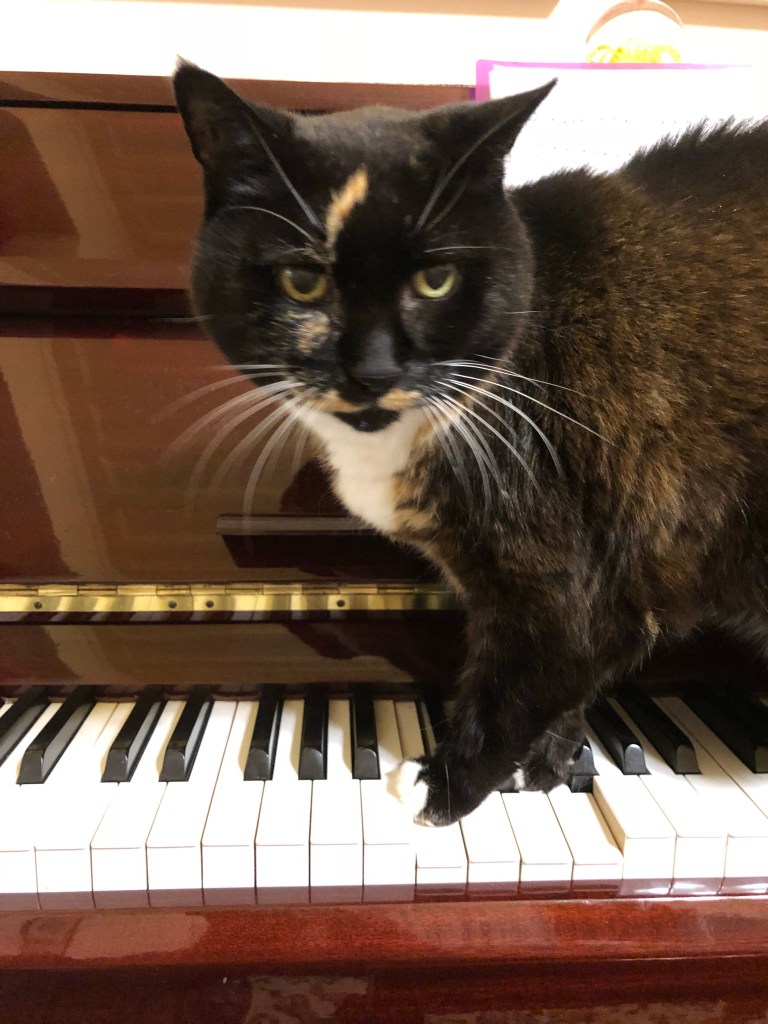
Daisy was a major distraction

I am resuming my efforts to learn the piano. I doubt I will ever achieve my ideal of playing Bach with fluency, but it would be nice to be good enough to play simple pieces for my own pleasure. Also, having reached an age when an alarming number of my friends are developing dementia, I hope it will help to preserve my brain power. Studies have shown that playing the piano improves memory, mental speed, concentration, and eye-hand coordination, as well as decreasing anxiety and boosting happiness and self-esteem.

As a child I had a few lessons which I didn’t enjoy, though I was glad of them when I started playing again after a gap of several decades and found I still remembered some basics which might have been hard to learn later on. I know it is important to have a teacher to encourage regular practice and progress along the right lines, but it can be hard to find a good one. I have had a couple who were mediocre, and one who verged on the sadistic – I imagine it must be frustrating for skilled musicians to have to earn a living by giving lessons to slow learners like myself. My most recent teacher was excellent but he is no longer available and will be hard to replace.

I have some excuses for failing to practise as much as I should. A major setback was breaking my wrist and being unable to play at all for almost a year. Movement of my right hand is permanently restricted, and it becomes painful if I use it for too long. The other main impediment is the presence of cats. When Daisy (pictured) was alive, she delighted in jumping onto the keyboard and marching up and down, with a preference for the bass. I sometimes wish I could have trained her to play proper duets with me, after the fashion of Nora the Piano Cat whose YouTube videos have brought her worldwide fame. Nora is a grey tabby, adopted as a kitten from a rescue centre and now almost 18 years old – a feline example of the health benefits of playing the piano? One of our present cats, Leo, distracts me by scratching rhythmically on some nearby piece of furniture whenever I start to play. Our other cat, Magic, has no interest in music at all.

“Three Novellas” ebook free this week

The ebook version of my Three Novellas is free on Amazon this week. It includes three gentle rather old-fashioned stories which, as it says in the blurb, “include elements of romance, medical mystery and the paranormal, reflect the author’s experience of practising as both orthodox doctor and alternative healer, and her leisure interests including animals and music”. I wrote them in the early 2000s, inspired by my experience of living between two countries after I emigrated from England to New Zealand. The first two, Carmen’s Roses and Blue Moon for Bombers, appear separate from each other but the third, The Windflower Vibration, shows them to be linked. Three Novellas was described by one reviewer as “a superb trilogy finishing with an interesting twist”. The Kindle version (which can be read on any device not just on a Kindle) is on a free promotion until 2 July 2023 and you can find it on your local Amazon site.

Jumping for joy

Ireland the Labrador greets me by jumping high in the air whenever I come to take him for a walk.

The two of us met about six years ago through The Dogshare Collective. One of his human family had suffered an injury at that time and needed help with his care. I started taking him out in the afternoons, and continued doing so long after his owner’s injury had recovered.

Ireland was bred to become a guide dog for the blind, but due to a minor defect in his own vision he was withdrawn from training and made available for adoption as a family pet. Large, friendly and exuberant, he loves playing with other dogs and like most Labradors he has an insatiable appetite. We have enjoyed many outings and adventures together (search the Animals section of my website to see illustrated posts about my walks with Ireland, also with my other dog share Buddy).

Having a dog brings great benefits – physical, mental and social – also involves great responsibilities. There are many people who are not in a position to have a dog of their own but would like to have a relationship with one. And there are many dogs who, often because their owners are out at work all day, need additional exercise and company. Within New Zealand The Dogshare Collective exists to put people from these two groups in contact with one another.

On Rangitoto

Rangitoto viewed from Cheltenham Beach

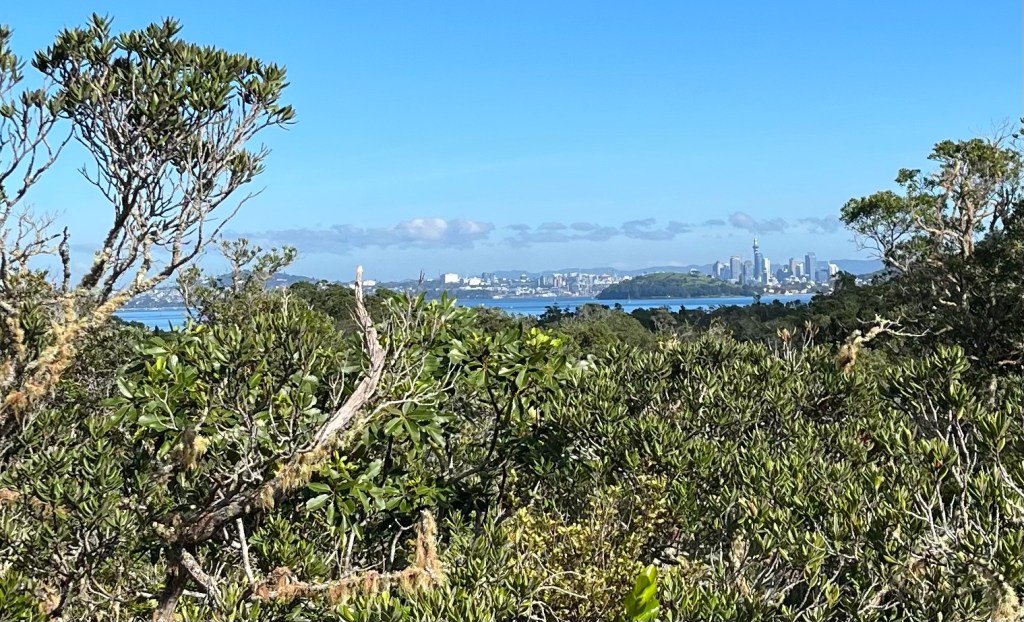
On a lovely sunny autumn day Brian and I visited Rangitoto, the volcanic island a short ferry ride from our home.

Disembarking from the wharf

We walked up the steep track towards the summit.

Lava beside the track
Auckland’s CBD in the distance

When we last visited some years ago we made it to the top, but not this time. Not only do we have less stamina nowadays, but the upper parts of the track are quite hazardous after the recent floods. So we went back down and sat in the sun to eat our packed lunch (there are no cafes on the island). Afterwards we walked along the coastal path towards Islington Bay.

On the coastal path

I was going to write a short description of Rangitoto, but thought AI might do it better. The following text was generated in a few seconds by ChatGBT.

Rangitoto Island is a volcanic island located in the Hauraki Gulf near Auckland, New Zealand. It is one of Auckland’s most iconic landmarks and a popular destination for tourists and locals alike.

Geology: Rangitoto Island is a volcanic cone that emerged from the sea around 600 years ago, making it one of the youngest islands in the Hauraki Gulf. It is part of the Auckland volcanic field, which consists of around 50 volcanic cones and craters scattered across the Auckland region. Rangitoto’s distinct symmetrical shape and its dark volcanic rock create a striking visual contrast against the blue waters of the gulf.

Natural Environment: The island is predominantly covered in dense vegetation, including native New Zealand flora such as pohutukawa trees, ferns, and shrubs. The pohutukawa trees, with their vibrant red flowers during the summer months, have earned Rangitoto the nickname “the Red Tree Island.” The island’s rugged landscapes and scenic trails provide opportunities for hiking and exploration, allowing visitors to experience its natural beauty up close.

Recreational Activities: Rangitoto Island offers various recreational activities for visitors. The island is accessible by a short ferry ride from downtown Auckland, making it a convenient day trip destination. Upon arrival, visitors can embark on walking tracks that lead to the summit of the volcano, offering panoramic views of Auckland’s skyline, the Hauraki Gulf, and the surrounding islands. Exploring the lava caves formed by ancient volcanic activity is another popular activity on the island.

Cultural Significance: Rangitoto holds cultural significance for the local Māori people, who consider it a sacred site. The island’s name, “Rangitoto,” translates to “Bloody Sky” in Māori, which is believed to originate from a historic battle that took place there. The island is home to archaeological sites, including Māori pa (fortified village) remains, which reflect its historical importance.

Conservation and Protection: Rangitoto Island is part of the Hauraki Gulf Marine Park and is managed by the Department of Conservation (DOC) in New Zealand. The DOC focuses on preserving the island’s natural environment, protecting its wildlife, and maintaining the integrity of its volcanic landscapes. Visitors are encouraged to respect the island’s fragile ecosystem by following designated tracks and leaving no trace behind.

Overall, Rangitoto Island offers a unique blend of natural beauty, volcanic history, and cultural significance. Its accessibility, diverse flora and fauna, and recreational activities make it an attractive destination for nature lovers, hikers, and those seeking a memorable experience in the Auckland region.

Animal exports; a moral dilemma

A ban on the export of live cattle, sheep, goats and deer from New Zealand will come into force this month, following years of campaigning by the SPCA backed by widespread public support. But we are having a general election in October 2023, and the National and Act parties have stated that if they come into power, live animal exports will be started again.

This practice is both cruel and unnecessary. A position statement from the SPCA has described the stressors on animals undergoing sea voyages lasting weeks or months: fear and anxiety, exposure to disease, overcrowding, overheating, motion sickness and more. Some animals die on board, and in 2020 almost 6,000 drowned when a livestock container ship en route from New Zealand to Saudi Arabia sank off the coast of Japan. And, depending on the adequacy of health and welfare in the destination countries, animals may be subjected to further suffering when they arrive.

There are alternatives to live export. Animals for food could be slaughtered here and their refrigerated carcasses exported. For breeding purposes, semen and embryos rather than live animals can be used.

This issue presents me with a moral dilemma. I don’t want to see the Labour Party returned again; since they have been in government New Zealand has gone backwards with falling standards in healthcare and education, increased poverty and crime, increased racial divisions, billions of dollars wasted on idealistic projects which have never been completed. Until now I had been firmly intending to vote for either National or Act, but how can I justify supporting a party which will reinstate live animal exports? Several letters published in the NZ Herald newspaper, including one from me, have expressed this dilemma. I have written to the party leaders, and my local MP, to protest the policy and I hope that if enough other people do the same they will revoke it. If not, is the only answer not to vote at all?

Books I’ve enjoyed #13

The current interest in issues of gender identity prompted me to read Radclyffe Hall’s autobiographical novel The Well of Loneliness, which was banned after its publication in 1928 but is now regarded as a classic. It is about a girl born in the late Victorian era to a wealthy family living on a country estate near Malvern. Despite being biologically female, ever since early childhood her appearance and behaviour has been obviously masculine. Although her parents feel greatly puzzled and concerned by her condition they never speak of it. When she grows up and falls passionately in love with another woman, her mother is forced to acknowledge her nature, and rejects her as “a sin against creation”. During later life in London and Paris she achieves success as a novelist and forms a loving relationship with a younger woman, but is eventually unable to withstand society’s condemnation of “inverts”. Nowadays her condition would be more widely accepted and she would be a candidate for sex reassignment surgery. This sad book contains sensitive descriptions of the main character’s tribulations, and of English country life as it used to be.

I listened to the audiobook version of Prince Harry’s memoir Spare. It is well written (by a ghost writer) and Harry narrates it fluently, He comes over as a fun loving but often troubled man whose most positive experiences have been his army service, his charity work with wounded veterans, and falling in love with Meghan. Although the text contains plenty of interesting material, it is pervaded by the author’s sense of victimhood, entitlement, hatred of the press and resentment towards the royal family. I feel these attitudes can only partly be justified by the trauma of losing his mother when he was eleven years old, terrible though that must have been. We await the next episodes of his life story.

Clare Chamber’s novel Small Pleasures is set in the suburbs of London during the 1950s. Jean is a middle-aged unmarried woman who works as a journalist on a local newspaper and lives with her demanding elderly mother. Her drab existence is enlivened after she begins research for a feature about a young girl who is allegedly the product of a virgin birth. The details of Jean’s domestic life, and the development of her character as she becomes emotionally involved with the girl and her parents, are engagingly described in a style reminiscent of Elizabeth Taylor or Barbara Pym. It must have been difficult to devise a satisfactory ending to the story and the last few chapters are not up to the standard of the earlier ones. Despite this criticism I very much enjoyed the book.

Books I’ve enjoyed #12

Girl, Woman, Other by Bernadine Evaristo, which won the Booker prize in 2019, is a series of vignettes about 12 women, mostly black lesbians in London, whose lives intersect. There is no punctuation and in parts the writing resembles free verse rather than prose. Neither the style nor the subject would normally have appealed to me, but having been given this book as a gift I felt obliged to read it, and was surprised how much I enjoyed it.

Kate Elizabeth Russell’s semi-autobiographical novel My Dark Vanessa has attracted much controversy, with one reviewer calling it tragic, repulsive and infuriating. As a 15-year-old schoolgirl in Maine, the narrator willingly entered into a sexual relationship with her 40-something English teacher. Their affair continues to impact her life many years later, especially in the light of the MeToo movement. It would be far too simplistic to describe this psychologically complex situation in terms of victimhood, abuse or even rape. A challenging but absorbing read.

Turning from books about the intricacy of sex and gender issues in today’s world to a refreshingly straightforward memoir of wartime service. A Spitfire Girl by Mary Ellis describes the work of the ferry pilots in the Air Transport Auxiliary, who transferred aircraft between RAF bases in World War Two. This remarkable woman flew over a thousand planes of 76 different types, ranging from Spitfire fighters to Wellington bombers. After the war she continued a long career in aviation, and died in 2018 at the age of 101.

I was feeling guilty about never having read Middlemarch by George Eliot, published in 1871 and widely considered the best English novel of all time, so I bought myself a copy for Christmas. I can see it is a monumental achievement, but with so many long descriptive paragraphs I am finding it hard going and have given up my intention of reading one chapter per day. I think this shows how much writing styles have changed over the years, also how my own attention span has got shorter presumably due to continual use of electronic devices.

I’ve been reading some lighter modern novels as well and will mention just a few. Small Things Like These by Claire Keegan is an elegantly written, quietly disturbing short book set in the 1980s in a rural Irish community dominated by the Church. The Lamplighters by Emma Stonex, inspired by a real event, is about the disappearance of three men from a lighthouse off the Cornish coast in the 1970s, and how the unsolved mystery continues to affect their wives many years later. Lastly, being a fan of psychological crime stories set in Oxford, I am enjoying Ruth Ware’s The IT Girl . A man serving a sentence for the murder of a college student ten years earlier has died in prison – but was he guilty after all?

Two dogs

Although I don’t have my own dog, I have the pleasure of knowing several local ones, and regular “dog sharing” arrangements with two of them: Ireland the Labrador and Buddy the Cavoodle. This involves taking them for walks, and sometimes keeping them company while their owners are out. I love both dogs equally, but they are so different from one another it can be hard to believe they belong to the same species, canis lupus familiaris.

Ireland the Labrador

Ireland is a confident, exuberant big black Labrador nearly six years old. He loves everything life has to offer: going for walks, playing with other dogs, riding in cars, and most of all he loves eating – almost anything except kidneys. His only fault is a tendency to bolt towards any source of food, such as a picnic or a discarded pie, which he can smell from far away. I have been walking him for about four years now and his joyful greeting when I come to see him always makes my day.

Buddy the Cavoodle

Buddy, a second generation Cavoodle just coming up to his first birthday, is a more sensitive soul and prone to anxiety even though he has been raised with the utmost kindness. He is gradually becoming more confident, and now enjoys going for walks although he was previously reluctant to leave the house. He still hates car travel, and in further contrast with Ireland he is indifferent to food, and often has to be coaxed into eating. Buddy is a very handsome dog, with an affectionate nature. He loves cuddles and is still small enough to sit on my lap.

The characteristics of Ireland and Buddy are typical of their respective breeds. For example it is well established that Labradors are obsessed with food, and that Cavoodles are prone to separation anxiety. Although the way that dogs are treated and trained has a big influence on their development, research has shown a clear genetic basis for inter-breed differences in personality, behaviour and intelligence. https://theconversation.com/genetic-research-confirms-your-dogs-breed-influences-its-personality-but-so-do-you-196274. Doing similar research on humans would be considered racist and unethical nowadays.

Thoughts on later life

“…we believe a full life is one that gets richer with age … rediscovering lost passions and plunging headfirst into new ones … embracing new experiences … bringing joy and meaning to every moment.” This is a shortened version of the text on the website of Ryman Healthcare. Is it realistic to expect old age, whether or not in a Ryman retirement village, to be so idyllic? Or is it more likely to be dominated by adversities such as loss of health and vitality both mental and physical, lack of occupation, reduced income, bereavement, loss of status, social isolation, and the prospect of death whether feared or welcomed? I expect it depends a lot on individual attitude.

Quite a number of my own contemporaries have died before reaching old age, having for no apparent reason developed some fatal disease, usually cancer. Others are still alive and during my recent holiday in England I had the pleasure of renewing friendships with some of those I have known for a long time – from high school, medical school, or hospital jobs in Southampton and Oxford. Since coming back home I have also met up with my New Zealand friends. Our conversations often touched on the question of how to adjust to retirement.

Almost all of us, in our 70s or 80s, have the good fortune to be living in comfortable circumstances with reasonably good health, family connections and ample money, allowing plenty of choice about how to spend our free time after leaving paid employment. My friends described a wide range of activities including charity work, looking after grandchildren or animals, gardening, travel, socialising, entertainments, reading, writing, cooking, painting, crafts, sports, fitness classes, music, academic study, spiritual practice.

Everyone seemed fairly content, especially those who were pursuing some compelling interest, or simply enjoying the freedom to relax and do just what they liked. Others, more introspective, found their lifestyle pleasant enough but questioned whether they were making the best use of whatever time might remain. Some were missing former jobs which had involved contributing to society and being recognised for it. They had not been able to find a type of voluntary work which made full use of their abilities and experience.

One woman who is highly artistic stated that the most vital thing was to express creativity, if only for oneself. I agreed that creativity is very important but felt that the resulting products should be shared with others. There is an example of these differing views at home, where my husband and I both spend a lot of time writing. He does it primarily for his own satisfaction and does not care much whether anyone else ever sees it. In contrast, I like to publish my work in the hope that some readers will benefit from my medical books or enjoy my novels – while trying not to be too flattered by good reviews or too upset by bad ones, for the Stoic philosophers advised against seeking appreciation. They said that the best way to live – at any age – is by striving to be a good person, and focusing only on things you control.