Bonnie the family dog

Nine months have passed since the last time I walked on Takapuna beach with my mother and Khymer. After both of them died I had good intentions of continuing the regular walks, in their memory, and for the health benefits of “earthing” barefoot on the sand. It wasn’t so much fun on my own and I soon gave up doing it.

But now Khymer’s family have a new puppy. Bonnie is a rescue dog, pedigree unknown, though pointer is certainly part of the mix. She is affectionate and intelligent and already, at about five months old, has learned to obey several commands.

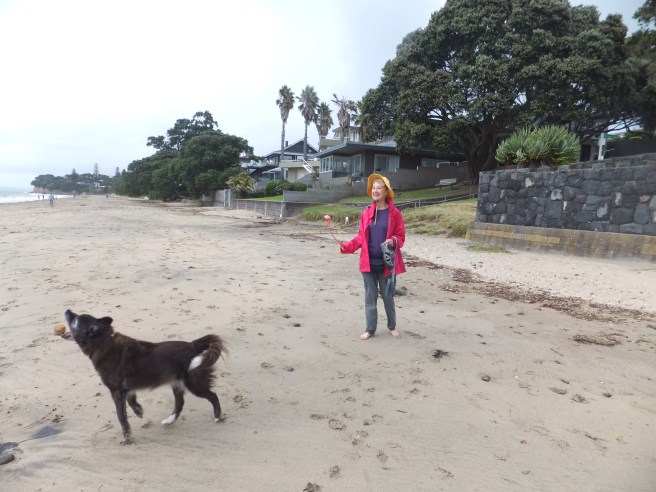
Accompanied by our niece Libby, I walked Bonnie for the first time today. She enjoyed chasing seagulls, retrieving her ball, playing with other dogs and splashing about in the waves. No dog can replace Khymer, but the circle of life continues and the bond with Bonnie will grow. I hope to be walking her for many years to come.

Bonnie 5 months old

Homer’s story

We have a fourth cat now, a companion for Magic, Leo and Daisy.

Some years ago a large white and black cat started making occasional visits to our garden, wailing like a lost soul. He was frightened and hungry, and after devouring any food I put out for him he would disappear over the fence and not come back for several days.

His distinctively marked tail, black with a white tip, helped neighbours and the local vet to identify him. Apparently he had been born and brought up in the street next to ours. When his owners moved to another suburb about 3 km away he did not settle, and made his own way back along busy roads to his original home.

I contacted his owners, who were pleased to take him back. They kept him indoors for three weeks. But as soon as he was released, he came back here. This scenario was repeated a number of times until I offered to adopt him and they agreed. I renamed him Homer.

Homer stayed at our house for a while, but still did not seem entirely happy. Then one day he followed us on a visit to my mother who lived nearby. He immediately curled up on her sofa and went to sleep. My mother did not particularly want a cat, but Homer refused to leave, and before long she became very fond of him.

clare & homer

So did Leo, a later adoptee, who loved going to visit Homer and seemed to regard him as a role model.

All was well until last year, when my mother went into hospital and eventually died there. Homer was distraught. He had to come back to our house for food, but was reluctant to stay, and could often be heard wailing outside at night. Three days before my mother’s funeral he went missing. After the service I went to check her house and found him lying semi-conscious on the doorstep with a swollen neck. I took him straight to the vet, and next day he underwent surgery for a large abscess.

Since recovering from that operation, Homer has at last become content to be part of our household. He gets on well with all the other three cats. He even jumps up on my lap to be cuddled now and then, and enjoys sleeping on flower pots.

Homer in garden pot


Happy birthday Marco and Polo

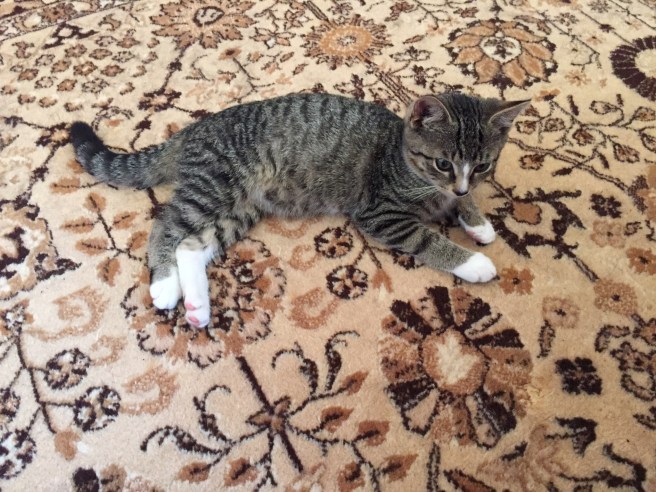
I had forgotten that today, 1st September, was the estimated date of birth of the two kittens I fostered last year. Here is a picture of them at about nine weeks old; the dark mackerel tabby is Marco (male), and Polo (female) is the tabby and white.

marco-polo-9-weeks-old


It was a lovely surprise this morning to receive birthday messages and photos from both their respective “forever homes”. I had been overwhelmed with applications to adopt them as soon as their details went up on the Lonely Miaow website, and it was up to me to select the most suitable ones – a big responsibility. Fortunately I chose well, for they quickly settled in with their new families and are greatly loved.

Fostering has both ups and downs. It was a lot of work looking after the two lively little kittens and they caused a fair amount of damage around the house. But we became very fond of them and could hardly bear to see them go. Fortunately I was able to keep in touch and visit them both now and then.


War and peace with Daisy

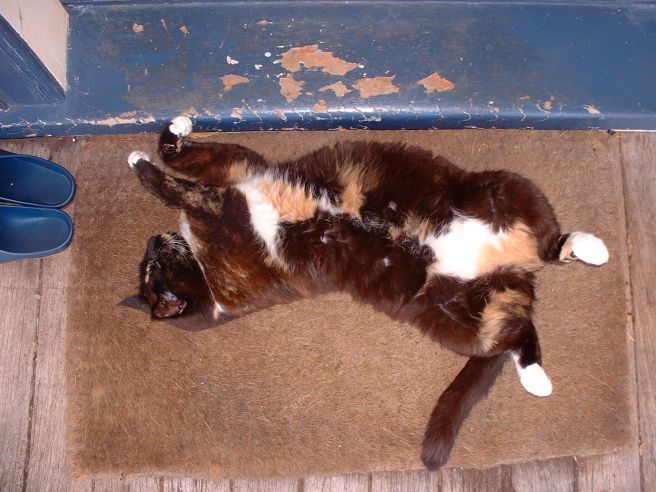
While kittens usually enjoy playing together, many adult cats shun the company of their own kind. Our Daisy, now aged about 13, does not like other cats at all. Although Felix was already well established in our household before Daisy arrived, she always resented his presence, and the two of them never became friends during all the years they lived together. Daisy prefers having contact with humans. She also enjoys lying on her back in the sun.

daisy-on-her-back


When I adopted Magic as a tiny rescue kitten, I had vague hopes that Daisy’s maternal instincts would be revived – after all, when Daisy first came to us, she had three tiny kittens of her own and was a most devoted mother. However, I was prepared for the likelihood that she would not welcome a new arrival, and this proved to be the case. I carefully followed the advice from SPCA Auckland about introducing a new cat – but with limited success. For several months, Daisy growled and spit whenever she saw Magic, and sometimes hit out in attack though never seriously hurt her. Daisy was equally hostile to Leo when he joined our household. This hostility continued as the kittens grew bigger. Fortunately neither of them seemed to mind it very much.

Last month I went to England on holiday (and took in a Thames cruise in aid of International Cat Care). All our three cats went into a boarding establishment while I was away – Magic and Leo were in shared accommodation but I invested in a private unit for Daisy. When I came to pick them up, the staff commented that Daisy had been an absolute delight. She had obviously relished the time in her own space with a view over the fields. And since they came back home, relations have been much more cordial. All three will now eat side by side, and even choose to sleep on (or in) the same bed.

Update January 2017

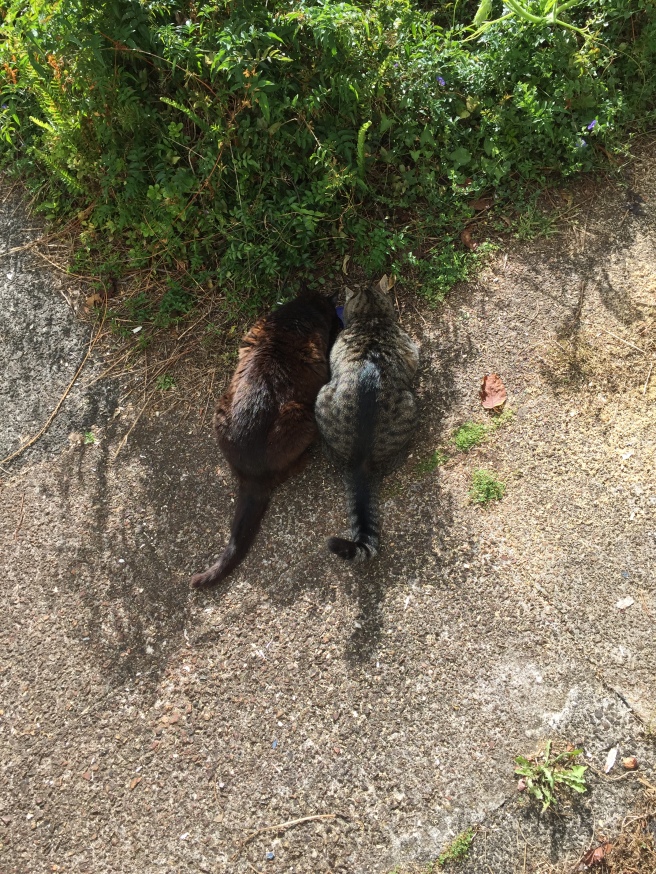
Daisy and Leo are now the best of friends as you can see.

daisy-leo-eating


Remembering Khymer


“What breed is he?” People often asked when they saw Khymer out with my mother and me on Takapuna beach. Suggestions included blue heeler, collie, German Shepherd, Staffordshire terrier, and even Dutch barge dog. But we never knew the details of his ancestry, exactly how old he was, or how he got his name. A member of our New Zealand family had rescued him from an abusive situation when he was young. He grew up into a fine dog; friendly, strong and handsome.

I had the privilege of walking Khymer almost every week since I met him nine years ago. He loved these walks, whatever the weather. He would bark at the top of his voice when I arrived to pick him up, pull me along the road at top speed until we got to the beach, then bark again until I started throwing the ball for him to retrieve. His favourite trick was swimming out to sea, dropping the ball, and waiting for me to wade in waist-deep and get it, so I had to wear special clothing when going out with Khymer.


We had many adventures in our early years together, but he gradually became more sedate. His eyesight and hearing were not so good, and he developed arthritis. He stopped swimming in the sea. But he loved his walks as much as always, even up to last week when I had to bring him home early because he seemed so tired. As if suspecting what was to come, I took a photo of him before I left.


A few days later I got the message – he had been bleeding from the bowel, was weak and in pain, and the decision to euthanise him that morning had been made. Given his age – at least sixteen, maybe more – everyone agreed that it would be pointless and unkind to do anything else. I arrived at the house just in time to join the tearful family gathered round his bed. When he saw me he barked and wagged his tail. I did not go with him to the vet, but have been told that his last minutes were very peaceful. Though thankful that his suffering is over, I shall miss our weekly walks so much. This is how I will remember Khymer:

khymer-catching-ball


When cats go missing


This is Magic looking wary and subdued after being rescued from 48 hours’ imprisonment in a neighbour’s basement.

magic-aged-9-months


And here is “little Leo” pictured three months ago as a new rescue foster kitten. He disappeared for several hours on his second day here, prompting a frantic search of the house and neighbourhood until he was found still in his own room – hiding up the chimney.

little-leo

Lost and found: how to search for a missing cat

Magic and Leo both went outside last Saturday evening. When I called them back at bedtime, Leo came in but Magic did not. I lay awake most of the night, listening for any sound of her presence, and getting up several times to look around the garden and the street without success. There followed two days of intensive searching. Although I did not have the same intuitive feeling which told me that Felix had died, after a second night had passed I had to face the fact that I might never see her again or know what had happened. Many friends and neighbours gave practical help and sent messages of support. And then came a phone call telling me she had been found locked up in the basement of a nearby house! She is now safely home – very hungry, in good shape physically, but emotionally less confident and more clingy than before. Leo was delighted to see her.

I think I did most of the right things, but I’ve now drawn up a checklist for what to do if a cat goes missing:

1. Be prepared in advance. Have your cat microchipped (yes, I’d done that) – consider a collar with a name tag (I’m thinking about that one) – take a series of photos of her from different angles, and update them as she grows up (this is very important, but I realised I had not taken any recent photos of Magic on her own since she was a young kitten).

2. Check your own property thoroughly, both inside and out – cats can easily get shut into cupboards or outbuildings – and check surrounding streets.

3. Contact your immediate neighbours to ask if the cat is trapped somewhere on their property – this is a very common scenario, as in Magic’s case.

4. Make up a flyer which includes the best photo, your address and phone number, a description of the cat and the date she was lost. Display copies outside your own house and in nearby streets, and at your local veterinary clinic, and consider a mailbox drop.

5. Alert all your other neighbours by text or email, including the photo, or calling at their houses. Ask them to look in their garages or sheds.

6. Post an online appeal: Facebook, local animal registers (here in New Zealand Petsonthenet), neighbourhood websites.

7. Phone local agencies: SPCA, Animal Control, veterinary clinics.

8. Worry won’t help so do your best to keep calm and look after yourself. Visualise your cat being well looked after somewhere and coming back home in good shape.

9. If and when your cat returns or you discover what has happened to her, remember to take down the flyers, inform all the above agencies and individuals what the outcome has been, and thank the people who have helped in the search.

Magic and Leo

I still miss Felix, but the two young cats who have now taken his place in our home are a great delight. A few weeks after adopting Magic from the SPCA, I agreed to foster little Leo for the Lonely Miaow. As soon as the two kittens set eyes on each other they started playing-fighting, and bonded so closely together that I decided to adopt Leo myself.

They are both happy, healthy and friendly but otherwise quite different in appearance and temperament. Magic, the black and white female with gold spots, is now around nine months old. She is a small cat, quick and graceful in movement, full of energy, a keen hunter and seems totally without fear. Leo the male tabby, though probably three months younger, is already bigger and heavier than Magic. He is a placid, cuddly cat with a very loud purr.

I wonder how much their differences in personality are due to genetics, and how much to environment. Being rescue cats, I presume they both suffered some adversity in early kittenhood, but I don’t have detailed knowledge of their backgrounds.

magic-leo-still-in-love


“Magic”

“Don’t get another cat that looks like Felix,” people told me. “You’ll only keep comparing them.” Sound advice, perhaps, but I decided to ignore it.

During my last volunteer shift at the SPCA I met a distressed young couple carrying a cardboard box. They told me it contained a live kitten who had been found, along with some dead ones, in the bush near their home in the country. I escorted them to the hospital block, where the box was opened to reveal a beautiful black and white Felix look-alike. Being assessed as a three-month-old male, this kitten must have been born around the same date when Felix died. Not that I believe in feline reincarnation, but it seemed like the hand of fate. I immediately applied to adopt him if and when he was ready to go to a new home, and decided to call him “Magic”.

An anxious wait followed. He had to spend a statutory seven days in the holding area in case an owner came forward. During this period there was a significant risk he would develop symptoms of cat flu or some other health problem. On the eighth day he would be microchipped and desexed, and hopefully be ready for adoption the day after.

Medically all went well, but when I rang to arrange the pick-up I learned that not only had Magic’s black and white coat developed ginger streaks, but that “he” had turned out to be a “she”.

It was a big shock. I was reminded of the scene in the film Carousel where Gordon McRae’s character realises that his unborn child might be a daughter instead of a son.

But like the man in the film I came to terms with the situation, and went ahead with the adoption. With her ginger streaks and feisty nature, Magic is not much like Felix at all. But she is a sweet, lively and affectionate kitten who has settled into our household right away and I hope will bring us love and joy for many years to come.


Foster kittens

As a result of the chain of events following the death of Felix I am now fostering two small kittens, a brother and sister whom I have named Marco and Polo. They came to me through the Lonely Miaow Association of Auckland, the same charity through which I acquired Felix fourteen years ago.

Marco is a male mackerel tabby, Polo a female tabby-and-white. Both of them are lively, playful,  friendly little cats. Fostering involves a lot of work but is very rewarding. I am busy all day long with feeding them, changing their litter trays, playing with them and keeping them out of danger.

I love them both, though not in the same way as I loved Felix, which is just as well because in a few weeks’ time I will have to part with them. When they are old enough to have been desexed, vaccinated and microchipped they will be ready for adoption.

Although Felix himself would no doubt have detested having them here, it is good to know that his death has had the positive outcome of helping other rescue kittens to find “forever homes”.