
 Magic (aged two years) is the most adventurous of our cats, sometimes to be found roaming far from home up on the mountain behind our house. She is also the only serious hunter in our feline family, being capable of catching large rats despite her delicate build. Magic’s small size is perhaps the legacy of a difficult start in life; she was brought into Auckland SPCA as a kitten, having been found cold and starving under a hedge beside her dead litter mates, and soon afterwards she became sick with cat flu and an eye infection. But she survived these traumas and has grown into a strong and healthy cat, with a ravenous appetite and a passion for raw chicken necks.
Author: Jennifer Barraclough
The challenges and rewards of volunteering
After I retired from paid employment I thought it would be a good idea to do some voluntary work. Having spent some years with other organisations I found my niche with Auckland SPCA, a charity which protects thousands of animals from neglect and abuse each year, and offers a variety of roles for volunteers.
The most important reason for volunteering is the altruistic one of contributing towards a worthwhile cause. Personal satisfaction comes secondary, however there are also benefits for the volunteers themselves: an enhanced sense of purpose, more social contact, taking more exercise and learning new skills can bring improvements in both mental and physical health.
Volunteering does not always work out well, and unsuitable people can be a hindrance rather than a help to the organisation they are meant to be serving. Those who have taken it up as occupational therapy for themselves can tend skimp on the more boring or arduous duties which are usually involved. Conversely, those who are carrying on from a sense of duty but not enjoying it can grow to feel martyred and burnt out. Retired people who volunteer for work related to their former profession can feel frustrated in a subordinate role where their knowledge and skills cannot be used to the full, whereas those who choose a new field can be daunted by the adaptation required.
Nowadays most organisations require aspiring volunteers to provide references, agree to police checks, attend training courses, and observe health and safety regulations. Becoming a volunteer is a formal process and a serious commitment, and helping out on a casual basis is seldom an option.
Based on my own experience in different settings, my advice to aspiring volunteers would be: Choose a cause that is truly important to you, keep the big picture in mind if the day to day work seems tedious, and persevere long enough to understand how the organisation works and get to know some of its employees. I currently volunteer once a week in the fostering department of the Animal Village, and also take some part in fundraising activities, having previously worked in the cat ward, adoption cattery and on reception. Rather than cuddling sweet kittens, volunteers in the feline areas are mainly occupied in such tasks as setting up cages, cleaning bowls and litter trays, and replenishing stocks of food; these may be mundane, but are essential to the over-arching aim of saving animals’ lives. The paid staff members value and respect the volunteers, and have been tolerant of my slowness in learning practical procedures and my clumsiness in letting a cat escape from her cage. They remain cheerful and friendly despite having to deal with some heartbreaking cases of animals in distress. A high proportion of these animals can be successfully rehabilitated and rehomed and one of them, my own cat Magic, will be featured in my next post.
Reflections about caring
This post is an extract from a work in progress, a memoir about the traumatic events that affected my family last year. If you have suggestions about how to make it more readable or relevant, please leave a comment below.
I found that looking after my husband following his heart surgery, and my mother during her last illness, was highly stressful even though it only lasted a few months and involved very little heavy hands-on work. The carers of patients who are disabled or demented must have far more arduous and prolonged ordeals to endure. The experience certainly made me appreciate the challenges of the caring role, with its somewhat uneasy combination of duty and privilege.
Studies from the cancer care setting indicate that levels of emotional distress among patients’ partners are similar, in both frequency and severity, to those for patients themselves. This is not surprising, considering that besides feeling sad and anxious about their loved ones, partners are often physically exhausted by providing practical care and running the household on their own.
There is a sensitive balance between attending to the sick person and meeting one’s own needs. Self-help authorities often say “Look after yourself first, or you will have nothing to give to other people”, usually quoting the airline safety message about putting on your own oxygen mask before assisting anyone else. This is sensible advice, but it can be difficult even to find the time for basic self-care, let alone take a break to enjoy something purely for fun or pleasure. One afternoon when Brian was in hospital, I found myself with half an hour to spare between appointments in the city, and impulsively decided to get a manicure. This frivolity gave a short boost to my morale, even though when I visited Brian in the evening he remarked that my bright pink nails made me look like a whore.
When my mother’s health was failing I discovered what a fine balance there can be between providing help and support that is appropriate to the patient’s needs, and seeming to be interfering with their independence and autonomy. Ideally it is best to check what the patient wants, rather than assuming you know what is good for them. But this does not always work, for sick people can make irrational choices, keep changing their minds, or be incapable of expressing their wishes, in which case the carers can only try to be tolerant.
While attention is focused on the patient, the carer’s vulnerability is not always appreciated, and I felt this a couple of times. A friend of the family sent two beautiful hand-painted cards, one for Brian and one for Clare, but did not send one to me nor mention my name on the messages inside. I did not blame her for leaving me out – I might well have done the same in the past – but, being at a very low ebb at the time, could not help feeling a twinge of self-pity. On another occasion, I phoned the hospital about 11 p.m. and asked to be put through to the ward where my mother was dying. The ward nurses had told me I could ring at any time, but the telephonist was reluctant to make the transfer, and sharply reprimanded me for calling after visiting hours.
Leaving these minor incidents aside, my relatives, friends and healthcare professionals were tremendously helpful to me both on practical and emotional levels. Research consistently shows that good social support is an important factor in buffering the adverse effects of life events, and my experience showed me that this is very true. I will always be grateful to those who took time to listen while I confided my troubles, brought meals to the house when I was too unwell to shop or cook, gave lifts to the hospital when I was too unwell to drive, or sent supportive emails from overseas.
My main confidant and support was Brian himself, and though we were close before his illness we have become even closer since. Finally, as an animal lover, I must also mention the comfort provided by the presence of our three cats.
Earthing; or, A virtual dog walk

Today I walked the length of Takapuna Beach without my shoes on. The sun was out, the tide was low, the sand was smooth and firm. Being near to such beautiful beaches is one of the best things about living in Auckland.
Walking barefoot on grass or sand is a natural way of “earthing“. Apparently this practice causes a transfer of electrons into the body, thereby helping to neutralise free radicals and reduce inflammation, so bringing about improvements in physiology. Research is still in its early stages but there is some evidence that earthing can help with numerous conditions including pain, insomnia, hypertension, cardiac arrhythmias and autoimmune disease. Certainly I feel in better health when I walk on the beach regularly, and often get new ideas for writing while there.
For eight years I used to take this same walk once a week, rain or shine, accompanied by my mother and a dog called Khymer. Then Khymer and my mother both died, my husband and I were both ill, and I gave up doing it regularly. Now I am determined to resume the routine. Having Khymer with me only in spirit does have one advantage; I no longer have to start early in the morning to comply with local regulations about the times when dogs are allowed on the beach.
Daisy the piano cat
Every cat is unique in appearance, personality and behaviour. Our black and white Magic is addicted to raw chicken necks; Leo the tabby likes to relax in the letterbox; and tortoiseshell Daisy is interested in music. My attempts to practice the piano are often interrupted when she jumps up on the keys and plays a loud accompaniment. Here is a short video of Daisy’s latest composition.
Daisy may not be so skilled as the famous American piano cat called Nora but then, like me, she only started learning to play in later life.
P.S. A reminder that my short novel Blue Moon for Bombers is free from Smashwords until the end of November. To download a copy click here.
“What are you writing next?”
I recently updated my author interview on Smashwords and one of the questions What are you writing next? made me review my future aims.
I am currently working on a short memoir about the catastrophic series of medical events that affected my family in 2015. There were two reasons for starting this project. First, I hoped that writing about what happened would help me come to terms with it better; as I discussed in an earlier post there is evidence that writing about illness and trauma can be therapeutic. Second, other people who are faced with the challenges of cardiac surgery, bereavement, and stress-related symptoms in themselves or their families might benefit from reading about what helped me to cope, or otherwise.
Writing this memoir is proving quite hard going. Perhaps I have reached the point of wanting to move forward in life rather than keep dwelling on what happened. I am also wary of conveying the negative and self-pitying attitudes which can so easily mar this kind of book. I look forward to writing something lighter, though my only recent effort has consisted of some sentimental poetry about cats.
What I would ideally like to write next is a really substantial novel. I have already self-published six short ones, and I think that like the vast majority of the thousands of new books coming out every day they are good enough to provide readers with a few hours of entertainment, but will prove to be ephemeral.
Nobody knows which, if any, modern novels will become classics but it is my personal experience that only the occasional book creates a lasting impression. For example, one that I have just finished reading is A Dictionary of Mutual Understanding by Jackie Copleton, a drama set in wartime Japan. I am never going to write a book of comparable quality, and the ambition of producing my own “magnum opus” seems likely to remain unfulfilled in this lifetime, but I do hope to be inspired towards something new. Meanwhile Blue Moon for Bombers, the middle volume of my Three Novellas trilogy, is free from Smashwords till the end of this month. To download a copy click here.
Homelands
Happier, healthier and several pounds heavier, I am back in Auckland after spending a sunny September in England. I’ve been lucky enough to be able to revisit my home country every year since we moved to New Zealand in 2000, and this year Brian came too. We were both anxious about travelling in view of our recent heart problems, so it was reassuring to discover that a consultant cardiologist was seated next to me on the outward flight. Neither of us needed his services and there were no medical emergencies during the rest of the holiday.
This visit was more than usually nostalgic, filled with reminders of my mother who died nine months ago. One sunny Sunday afternoon a group of cousins from her side of the family, the Guys, gathered for a picnic in the grounds of Gray’s Inn; our homes are so widely scattered around the UK and overseas that many of us had not met for decades. I had a friendly meeting with my first husband, having resumed email contact with him after my mother’s death. I walked on the sands at Margate in Kent, where my mother spent part of her childhood. And scattered a portion of her ashes beside her brother’s grave in the churchyard of the Yorkshire village where she lived in later life. Thanks to her wartime service in the British Army, I was able to stay at the Victory Services Club in central London, an ideal base for making daily trips around the country with my Britrail FlexiPass.
There have been other deaths among my UK contacts in the past year: two close friends have been widowed, another couple have lost a son, others are getting old and unwell, so some of my visits were tinged with sadness. But I still have many relatives and friends around the country, including some younger ones I did not know before, and though there was not enough time to see them all I did meet people from diverse places: Malvern, Frome, Gosport, Winchester, Kirk Hammerton, Oxford, Dorchester on Thames, Hythe, Manchester, Birkenhead, Shetland, Soberton Heath, Saffron Walden and various parts of London. Everyone was so kind and hospitable – thank you! Here I am in Sue’s allotment, with Sara’s dog, and with Brian in Oxford University Parks.
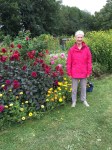
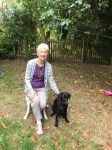
There were sightseeing visits too, to Charles Darwin’s home at Down House and the Sackville-West estate at Knole, both in Kent. My most adventurous solo trip was to Limerick, a first step in exploring my Irish ancestry on the paternal side, a topic I may write about in a future post. Limerick seemed a charmingly old-fashioned small city, so quiet and peaceful after London, and I had a lovely view of the River Shannon from my hotel room.

As always these visits make me question where my true home is, but at least for now it is in Auckland, and it is good to be back as England turns towards autumn and New Zealand to spring. Wearing clothes in different colours, after the all-blue wardrobe I packed for the trip. Thinking about writing another book. Being reunited with my cats.


“Unfaithful unto Death”
My latest novel is a black comedy called Unfaithful unto Death. Here is a short extract:
Chapter 1: A Doctor’s Lot
Somewhere in southern England around 1980
Evening surgery was running late, and Dr Cyril Peabody wanted his dinner. He tried to ignore the rumblings of his empty stomach and concentrate on his work.
His tenth patient, the village postmistress, waddled into his consulting room with maddening slowness. “Evening, doctor.”
“Yes, Mrs Bream, what’s the trouble?”
“Just a touch of indigestion, I shouldn’t wonder,” she replied complacently.
Cyril did not consider this an adequate reason for taking up his time on a fine Friday evening. He said “You’re grossly overweight, you know.” Mrs Bream looked so indignant that he tried to make a joke of the matter by rubbing his hands together and adding “Don’t worry, my dear madam, we’ll soon have you looking as sylph-like as a schoolgirl once again.” She gave him a hostile stare.
“Now. What exactly do you mean by indigestion?” asked Cyril.
Mrs Bream looked at him as if he was a backward child. “Dr Greatorex used to give me some white medicine,” she informed him.
Cyril murmured “Curse these country bumpkins” to himself as he wondered how far to investigate her case. He wrote in Mrs Bream’s file “?Indigestion?” enclosed by prominent quotation marks, and added “Low IQ.” He recalled with nostalgia his time as a hospital doctor, when there would have been a student nurse to undress this old biddy ready for him to carry out a physical examination, and to write out the cards for the relevant tests: chest X-ray, barium meal, cholecystogram, full blood count, urea and electrolytes, liver function, ECG. As it was, doing it all himself did not seem worth the effort.
He reached for the prescription pad, saying in a bracing tone “Jolly good. I’ll give you some more white medicine. Come back and see me if by any chance it doesn’t do the trick. And we need to get rid of a stone or two.”
“Evening, doctor,” said Mrs Bream, and before she was out of the room, Cyril firmly pressed the bell for his last patient: Sebastian de Winter, age forty-four, of Easton Green Manor.
Sebastian de Winter was a giant of a man with a thatch of black hair, a jutting forehead and a worried expression. He glanced suspiciously at the notes on the desk. Cyril asked briskly “Well, Mr de Winter, what’s the trouble?”
“I had another bout of chest pain after lunch today. Scared the hell out of me. My blood pressure’s way out of control – you know that I suppose? Garth Greatorex has been handling the problem but he’s off duty this evening. Well, you know that too of course.” The patient leaned forward and continued earnestly “Frankly, Dr Peabody, I want a second opinion. They tell me all this is due to stress. It’s a month since I had a full physical checkup, and I’d like you to give me another ECG.”
Cyril’s interest was aroused by talk of chest pain, blood pressure and ECGs. He decided to ignore the mention of “stress”, for it would be too bad if this case turned out to involve one or both of his two pet hates, “social problems” and “psychiatry”. Cyril was interested in human bodies; he enjoyed finding out what was wrong with them, and gained satisfaction from putting them right. He was not at all interested in the human mind. He replied “By all means, Mr de Winter, delighted to oblige. As you may know, I had a great interest in cardiology in my most recent hospital post. We’ll give the problem a thorough review.” Fatigue forgotten, he rose to the challenge of demonstrating his medical expertise and, with any luck, outshining his senior partner Garth Greatorex in diagnostic skill.
Sebastian de Winter gave a history of chest pain occurring after meals and accompanied by a sensation of dread. He also complained of headaches and disturbed sleep. Cyril did not ask about his personal circumstances but the patient volunteered an account. The symptoms had started soon after his father’s sudden death from a heart attack. Sebastian had inherited the Easton Green estate with two hundred acres of farmland, and a vineyard just starting production. The burden of managing these assets was a heavy one, and his wife did not give much support. He was drinking up to half a bottle of Scotch every night in an attempt to relax and get a few hours’ sleep. He worried about his high blood pressure; Dr Greatorex’s various prescriptions had either failed to bring it down, or caused unacceptable side effects.
Physical examination revealed no abnormality except a raised blood pressure reading of 175/95. Cyril fetched the portable ECG from the clinical room. He took pride in this machine, which had been out of order when he arrived at the practice. He had got it working properly and used it on many of his patients, though none of the other doctors showed any interest in the tracings he obtained.
Sebastian de Winter’s ECG showed mild left ventricular hypertrophy, but Cyril felt able to give an honest reassurance that it was “essentially within normal limits”. The patient replied “Thank God.” Cyril wondered what to do about the raised blood pressure. The man had already been tried on many of the standard drugs: frusemide, propranolol, bethanidine, methyldopa. In the drawer of Cyril’s desk there were some free samples of a new drug called Amaz. It was claimed to reduce blood pressure by some novel mechanism that Cyril could not remember. Recalling the excellent lunch at the Angel’s Arms which Millford Pharmaceuticals had given to celebrate the launch of this new product a week or so before, Cyril announced “I’m not too happy about the blood pressure, but I’ve got some splendid new tablets here which should bring it under control. Come back next week and we’ll see how they’re suiting you.”
“The stuff Greatorex gave me made me feel sick as a dog all day,” said Sebastian de Winter mournfully. “I suppose I’ve got to expect the same with these.”
“Nausea is a common side effect from medication of any kind,” Cyril told him. He added an opinion of his own “Mainly psychological in origin – don’t think about it and you won’t get it, in other words.”
The patient made no move to leave. He asked “Couldn’t you give me something to help me sleep?”
“Never prescribe sleeping pills. Deplorable things,” said Cyril, who never suffered from insomnia himself. He had had enough of the consultation, and was determined not to be drawn into anything that smacked of psychiatry or social problems. Defeated, Sebastian de Winter put the bottle of Amaz into his pocket and shambled out of the consulting room.
Eight o’clock. Cyril put his stethoscope into his medical bag, snapped it shut, and was striding out of the Health Centre when Linda, the young receptionist with the fluffy blonde hair and curvy figure, waylaid him. “Dr Peabody! There’s two late visits come in!”
He cursed his bad luck under his breath. “Not your day, is it?” remarked Linda brightly.
“I sometimes think a doctor’s lot is not a happy one, Linda. Are these visits really that urgent?”
“Well, I should think the first one is. Poor Mr Harland, he only lives up the lane there, he’s got lung cancer and he’s very bad. His wife’s a nurse at Harphamstead Hospital – she wouldn’t ask for a visit over nothing, I’m sure.”
“Suppose not,” said Cyril. “And what’s the other?”
“Old Miss Gray from Cottage 2 by the duck pond. Says she wants to see one of the male doctors urgently. She’s a little bit eccentric, you know,” said Linda. “Actually, between you and me, she’s plain batty. Don’t tell anyone, but she came round here one day and told the whole waiting room Dr Greatorex was a brazen libertine – whatever that may mean. He was awfully cross.”
Cyril smirked with relish over the anecdote. He asked “And what’s wrong with this Miss Gray?”
“She wouldn’t say. She wants to speak to you in confidence.”
“And where is this duck pond?”
“In the dip past Graves Farm. At least it’s on your way home.”
Cyril did not appreciate the tranquil summer evening scene as he drove away. He was beginning to suspect that his recent career change had been a big mistake. His only previous experience of family medicine had been as a single-handed locum in a quiet West Country practice during his summer holiday. He had rather enjoyed that, and considered he had achieved several significant diagnostic triumphs. But working as a dogsbody at Market Beeching Health Centre, with the senior partner breathing down his neck, was what his mother would call quite a different kettle of fish.
***
Unfaithful unto Death is available for Kindle or in print from Amazon.com or your local Amazon site, and as an ebook from Smashwords and other online retailers. Please share this with any of your contacts who might enjoy it.

Tarot
Many years ago a friend introduced me to the fascinating and mysterious world of the Tarot, a set of 78 cards that has been used since ancient times for divination and as an aid to psycho-spiritual development and intuition. Its origin is unknown; the complex images could be seen to derive from the myths, legends and belief systems of many civilisations including those of Egypt, India and China, and it has been known in Europe since at least the 14th century. There are numerous different decks available, featuring artwork in styles ranging from the traditional to the quirky.
I studied the Tarot myself for a while and did occasional readings for friends, but was perhaps deterred from continuing when I realised what powerful effects the symbols could have. With their universal relevance they almost always seem to relate to the life situation of the “querent”. One woman told me afterwards that her chosen cards had been instrumental in her decision to divorce her husband; fortunately this turned out a good decision. One man took his spread to be predictive of his own death, despite my efforts to interpret it more constructively, and he did die suddenly not long afterwards. It is indeed hard not to be shocked and distressed by some of the cards, such as Death, The Hanged Man and The Devil, even though they are not intended to be taken literally; instead, they symbolise in different ways a common Tarot theme, that of letting go of the old to make way for the new. Other cards, such as The Star and The Sun, show much more beautiful and positive images. Whether or not the Tarot has any occult significance, as opposed to being a psychological tool, I think it should be regarded with respect and not used frivolously.
The insightful reading I had yesterday from Samantha Jung-Fielding stimulated much reflection and promise for the future. To summarise just a few of the cards that particularly resonated with me: Ace of Swords: change beginning on the mental level with new attitudes and ideas. The Empress: creativity and abundance, happy relationships. Nine of Swords: fear and despair, but the threats are in imagination rather than reality. The Fool: appearing as the final card in my spread, this represents the start of a new adventure! My complete Celtic Cross spread is pictured below.

Memories on Milford beach
In this morning’s winter sunshine we walked along the bottom of the cliffs between Takapuna and Milford, part of Auckland’s North Shore Coastal Path. This must be one of the best short walks in New Zealand but, as the warning sign says, it “requires a reasonable level of fitness and is not suitable for prams”. It is not really a path at all, but involves stepping over mounds of black boulders and lava flow, the residue of long ago volcanic activity from what is now Lake Pupuke. In the middle there is a narrow concrete section with a steep drop on both sides. At low tide, the rock pools and golden bathing beaches are exposed. At high tide there is a risk of getting soaked by the waves crashing against the rocks. There is a spectacular view across the sea to the island of Rangitoto, another extinct volcano.
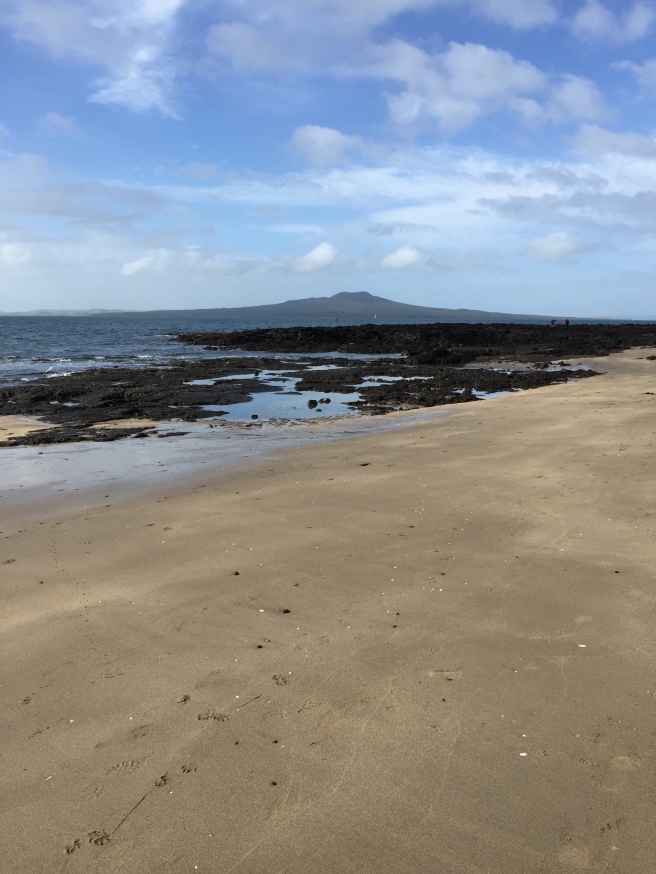
This walk holds many memories for us. Towards the Milford end we pass the house where Brian and his brother grew up. When his parents came to live there in the 1930s it was a modest weatherboard dwelling. There was no heating and the roof leaked, but having a beach outside the garden gate provided a wonderful outdoor environment for children. In the early 1980s, after Brian and I had met in England, we came out to spend holidays there. His mother looked after us beautifully and I remember idyllic hot summers when we went swimming every day and drank gin in the evenings. Now the house, no longer in the Barraclough family, has undergone a multi-million dollar conversion. The only reminder of Brian’s parents and brother, all now dead, is a plaque on the bench outside the fence.
 Jennifer Barraclough